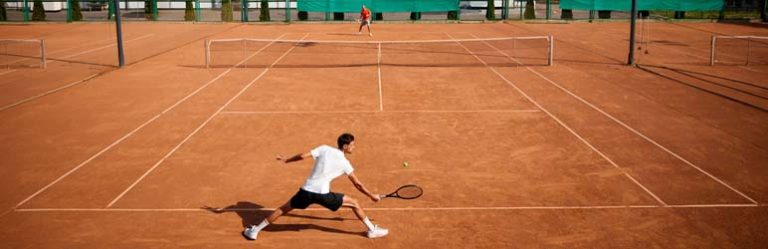
Tennis betting in Texas isn’t as simple as picking the player with the biggest serve or the flashiest number on their ranking. You need to take into consideration one thing often missed: the type of court the match will be played in. Each court type has its advantages: hard, clay, or grass. While making tennis bets in Texas, knowing the type of court on match day could serve you well.
Let’s get straight to the point. Every tennis bettor loses money for the simple reason of looking at every match the same way. A player with a strong record on hard courts could struggle with clay. Another player may struggle with grass, but in fact, excel on that same surface. The surface is a huge determinant in how a player performs, and while making bets, it has to be at the core of your strategy.
The Three Court Surfaces — and Why They Matter
Tennis has three major surfaces:hard, clay, and grass. Each one has its impact on ball speed, bounce height, and player movement. Here’s how that breaks down:
- Hard Courts- Most frequently found in u.s and during indoor events. Ball speed is moderate, and the most hit level is a consistent bounce. Most pros learn on this surface first, which makes it the baseline — pun intended — for performance comparisons.
- Clay Courts- This is a slower surface and has a higher bounce. Best for players who have great endurance and use a lot of heavy topspin. Think Rafael Nadal. Guys who have a big serve and rely on a lot of quick points don’t do well here. It’s a grind.
- Grass Courts- This is both the least common and the fastest surface of them all. The serve has a low bounce which helps big servers and aggressive net players shine.
The advantages differ with each surface and if you ignore them, you’ll be guessing. If you factor it in, you’re thinking like a pro.
Match Styles Get Flipped by the Surface
In analyzing a match, don’t just look at rankings or won-loss records; try to analyze where those wins really came from.
Some players may perform quite well at the 250 level, excelling at the tournaments on hard courts, but tend to struggle on the European clay. Other players seem quite average until it gets to grass season, and then they perform quite well. It seems like they go deep into every draw, but they just have those styles that work on one surface.
Take a player with a low-power, flat groundstroke game. They might have no problems breezing through matches on faster hard courts. But that same player would struggle on the slower clay. There, their shots tend to “sit up” too much, and a heavily topspin player who enjoys long rally matches would have a field day.
You have to consider the “style vs surface” concept, that is a dimension most bets would completely miss and the collective context would just enhance every bet made.
Head-to-Head Doesn’t Always Mean Much Without Surface Context
A lot of bettors rely on head-to-head records. And yes, it’s a good data point — but only if you add the surface angle.
Take two players who’ve played five times. If all five matches were on hard courts, and one player is 4–1, that doesn’t mean they’ll win again if the next match is on clay. Different court, different match.
Here’s a practical example: Daniil Medvedev vs. Stefanos Tsitsipas. Medvedev owns their hard court meetings. But put them on clay, and Tsitsipas has a real shot. Betting only on historical records without checking the surface is lazy — and costly.
The Underdog Advantage Grows or Shrinks Depending on the Court
It’s not just favorites that get impacted by the court surfaces; they also change the level of danger posed by the underdogs.
For instance, clay courts tend to benefit lower-ranked players. How? More extended rallies increase the chances of making mistakes, and strategy becomes more important than raw power. That’s how lower-ranked players can sneak past grinders and steal sets — and sometimes matches.
Big servers (and players in general) have the opposite advantage on grass. Short points can be won in a heartbeat, which greatly hinders underdogs’ chances of a comeback. If the underdog fails to break serve, they lose.
This is important when you are checking the spread, set betting, or picking an underdog moneyline. Understanding the court’s influence on the game’s tempo can help a lot.
Look at Player Form — On That Surface
Another mistake is focusing on recent form without considering the surface. Maybe a player is 10-2 in their last 12 matches. That seems good. But what if those 10 wins were on hard courts and the player is about to compete on clay? Major warning sign.
The best Texas sportsbooks offer surface-specific data if you look hard enough. Search for segment win rates by surface, holds versus breaks, point construction, and other metrics. Those stats don’t lie, and many times, they’ll provide the truth that rankings will miss.
Injury History and Surface Stress Go Hand-in-Hand
The joints suffer a lot when playing on hard courts. Clay surfaces do not hurt as much, but they can be tough on hips and backs since people slide on them. Grass courts are more forgiving, though they can be slippery.
Different types of surfaces will impact a player’s injuries in different ways. For instance, a player recovering from knee surgery might seem fine on grass, but they will have a harder time on hard courts. Players who constantly tape up their shoulders will be better off on grass, which allows them to end points more rapidly.
Make an observation of the injuries and pay attention to the details of the surface. Some injuries will hurt more due to specific surfaces.
Tournament Location Also Plays a Role
Keep in mind the changes made by the tournament organizers related to elevation, humidity, and court speed. Indian Wells is classified as a hard court, but the desert air makes it play slower. Madrid is a clay court, but the high altitude makes the ball fly faster than normal. Depending on the weather, Eastbourne grass courts can be quicker than Wimbledon’s.
All “clay” or “hard” courts do not look and play the same. Look into the specific event location. Temperature, altitude, and even the last time it was mowed can all affect the speed of the court.
Live Betting? Watch the First Few Games for Surface Read
If you’re betting live — which many do while in Texas via various platforms — the first few games tell you a lot. Is the ball flying through the court? Are players struggling to hold serve?
Watch how quickly the ball moves and how players adjust. Surface impact is clearest when you see how it affects rhythm, serve effectiveness, and rally patterns.
Make adjustments fast — smart live bettors do this instinctively.
Frequently Asked Questions
Q: How Do Tennis Betting Odds Work?
A: Tennis betting odds represent how much you can win based on your bet. For example, +200 means a $100 bet wins $200. -150 means you need to bet $150 to win $100. They also imply probability — lower odds mean higher expected chance of winning.
Q: What’s the Most Common Court Surface in Pro Tennis?
A: Hard court. Most ATP and WTA events, especially outside Europe, are on this surface.
Q: Do Players Have a “Home” Surface?
A: Yes. Many South American and European players grow up on clay. Americans and Australians often start on hard courts. It shapes their game.
Q: Should I Bet on Underdogs More on Clay?
A: Sometimes. Clay tends to reduce the gap between top players and grinders. But matchups still matter more than rankings.
Q: Can Court Surface Change During a Tournament?
A: Not technically. But wear and weather can affect speed and bounce — especially on grass or outdoor clay.
Why Surface Knowledge Beats Blind Betting
If you’re trying to make smart tennis bets while in Texas, start by asking one question: what surface is this match on?
Everything else flows from that. The way the ball moves. The way players move. Who has the edge. Who’s hiding a weakness. Court surface is the filter that gives stats real meaning. Without it, you’re flying blind. With it, you start seeing edges others miss.

Hilbert Mayer
Sports Writer
Hilbert Mayer is a professional sports writer, betting analyst, and content strategist with over 15 years of experience in the sports industry. Before focusing on sports betting analysis and handicapping, Hilbert worked as a sports writer for various news outlets, covering everything from game recaps to in-depth matchup features. Today, he specializes in MLB, NFL, March Madness, and UFC betting, combining his journalistic background with deep statistical expertise and real-world betting insights. His proven track record, sharp reads, and ability to break down complex matchups make him a trusted voice among both casual bettors and seasoned sharps.
Published on: July 28, 2025
Last updated: July 28, 2025