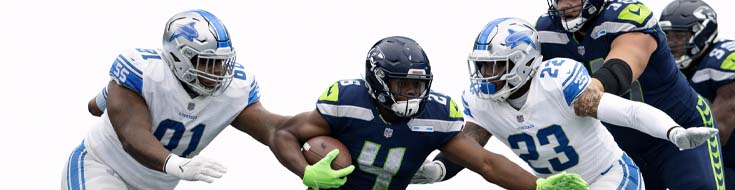
Super Bowl week always pushes bettors toward star players and clean narratives. That’s how Super Bowl LX player prop betting gets shaped in the public market. Big-name NFL running back. Neutral field. Championship game. It’s simple: give him the ball, get the rushing yards, & hit the over.
Kenneth Walker III fits this perfectly. Productively dominated the season. Clear lead back, no weather concerns. And still, when you slow it down and actually look at how this game is supposed to go, over on his rushing yards looks pretty weak.
This is not an indictment of Walker’s talent, though. More simply, it’s the math & game flow & how the likely outcomes fall short of the number the sportsbooks are posting.
Updated odds snapshot
| Market | Line | Over | Under |
| Rushing yards | 77.5 | -114 | -114 |
The important aspect is not the juice – it is where the line is. Sitting at mid to high 70s is a really tough ask for any back in a game that figures to be close.
Start with The Baseline, Not The Ceiling
Walker had a good but not exceptional 2025 regular season. He ended with 1,027 rushing yards, 4.6 yards per carry, and completed 221 rushing attempts. Solid and reliable, yes. But his production barely carried over 60 rushing yards a game.
That is relevant because sportsbooks have higher expectations for him. They want him to surpass his season average by a large margin. And all this in a game with high stakes and slim margins.
To obtain 78 rushing yards, Walker realistically needs one of these three things:
- A good amount of carries with decent efficiency
- A long and easy touchdown
- A scenario at the end of the game of running down the clock
These outcomes occur, but not very often, and certainly never in the Super Bowl.
The Spread Tells You More Than The Hype
Seattle’s betting odds have them as a 4.5 point favorite with an over/under set in the mid 40s. This indicates the expectation of a competitive game, rather than a blowout.
This expectation is important for line prop bets.
When teams are winning by double digits in the second half, they can run the ball as much as they want. However, in close games, there is going to be less running. Coaches tend to keep the game plan balanced, with a focus on passing efficiency, and to keep the game in control with a balanced run.
Just because a game is 4.5 points doesn’t mean that there is going to be plenty of running in the 4th quarter. There will be a lot of unpredictability in the game. This unpredictability favors the under on prop bets.
“Featured Back” doesn’t mean “Automatic Over”
This is where casual bettors get burned.
Walker can be showcased and still underperform. Let’s consider an example of a realistic stat line:
- 18 carries
- 74 rushing yards
- 4.1 yards per carry
That’s a productive stat line, and Seattle would happily take that. And that still loses the over at 77.5
When numbers get close to 80, even efficiency won’t be good enough. You need volume or a singular big play. Betting overs at that range is betting that more will happen than normal football, not just an extra.
New England’s Defensive Incentives Work against Volume Rushing
The Patriots don’t need to completely shut down runs to be successful. They just need to prevent Seattle from dominating early downs.
If New England routinely keeps Walker to under three yards on first down, the entire offensive structure has to shift. Second and long means more shotgun, more passing, and more play calls that don’t include a handoff.
That doesn’t mean Walker disappears. It just means the offense caps his carries.
And keep in mind, stopping runs on early downs is a choice a defense will often make. They will give up short passes in an attempt to prevent the offense from getting back on schedule. That directly reduces the number of runs without showing a defense is “bad” on the stat sheet.
Passing Usage Can Quietly Drain Rushing Opportunity
Another angle working against the rushing over is Walker’s involvement in the passing game.
Seattle is comfortable using him on screens, flares, and checkdowns when defenses load the box. Those touches count for real football value — but they don’t help a rushing prop.
If Walker finishes with, say, five catches for 25 yards, that’s still five offensive touches that didn’t move his rushing total. And it’s entirely plausible in a game where Seattle wants easy completions and ball security.
Rushing overs don’t benefit from versatility. They benefit from narrow usage. And Super Bowls tend to reward versatility instead.
Late-Down Usage and Rotation Still Matter
Even with Walker as the clear lead runner, Seattle has shown a willingness to rotate backs situationally. Passing downs, hurry-up sequences, and certain protection packages can pull him off the field.
Each missed snap reduces the chance of stacking carries within a single drive. That’s how rushing totals often get there — not one carry at a time, but four or five in a row when an offense is rolling.
In tight games, those sequences are harder to come by.
The UNDER Survives Chaos — the OVER doesn’t
Super Bowls rarely play clean.
Timeout-heavy halves. Long reviews. Commercial breaks killing tempo. Conservative red-zone play-calling. One negative run or holding penalty wiping out progress.
The under doesn’t need perfection. It can survive:
- A stalled drive
- A sack that forces a punt
- A three-and-out after a big run
The over, especially near 80 yards, usually needs cooperation. One missed opportunity can be the difference.
That’s why books shade these numbers upward. The public bets optimism. The math doesn’t.
Line Value Matters More than the Player
There is a real difference between 75.5 and 77.5. Two yards might not sound like much, but it changes the probability curve.
At 75.5, one solid drive late can save the over. At 77.5, that same drive still might not be enough.
If you’re betting Walker’s rushing total, you’re not betting “Will he play well?” You’re betting “Will this game break the right way?” And at this price, it doesn’t have to break the wrong way for the under to win — it just has to break normally.
Pick: Kenneth Walker III rushing yards — UNDER 77.5
This number assumes an aggressive, efficient rushing script in a game that projects to stay tight. Walker doesn’t need to struggle for this bet to cash. He just needs the game to behave like most Super Bowls do.
Shop the number, not the narrative
If you’re serious about props, you already know the drill. Always shop. Always compare. Always respect how much two yards can matter in a rushing market.
That’s why the choice of book matters almost as much as the pick itself. Limits, alternate lines, and pricing flexibility are where the best Super Bowl betting sites separate themselves — especially when the edge lives in the margins, not the headlines.

Hilbert Mayer
Sports Writer
Hilbert Mayer is a professional sports writer, betting analyst, and content strategist with over 15 years of experience in the sports industry. Before focusing on sports betting analysis and handicapping, Hilbert worked as a sports writer for various news outlets, covering everything from game recaps to in-depth matchup features. Today, he specializes in MLB, NFL, March Madness, and UFC betting, combining his journalistic background with deep statistical expertise and real-world betting insights. His proven track record, sharp reads, and ability to break down complex matchups make him a trusted voice among both casual bettors and seasoned sharps.
Published on: February 3, 2026
Last updated: February 5, 2026