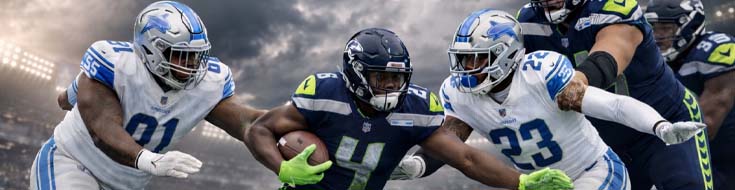
Walker’s prop bet for receiving yards has been one of the more interesting talking points on the Super Bowl LX boards and, more specifically, the Super Bowl betting sites that focus on player prop bets. This isn’t about hyping and guessing playing time. It’s about Seattle’s offense and how it performs when the game is close, the way New England defends the space underneath, and how sports betting makes decisions based on correlation rather than just volume.
Walker continues to be a primary runner, but his role in the passing game is no longer just a situational filler. In a Super Bowl context, there is more at stake (thus more possible game scenarios to consider) than in a standard regular-season game, which is exactly why the line on Walker’s receiving yards is important.
Updated Super Bowl LX Odds: Kenneth Walker Receiving Yards
The following are concordance figures compiled from leading sportsbooks such as Betnow.eu. Compared to prior posting windows, lines are tightening, and the variance across sportsbooks has decreased.
| Prop Market | Line | Odds |
| Kenneth Walker III Receiving Yards | 24.5 yards | -110 |
| Over 24.5 Receiving Yards | -110 | |
| Under 24.5 Receiving Yards | -110 | |
| Kenneth Walker Receptions | 2.5 | -120 |
| Walker Rushing + Receiving Yards | 98.5 | -115 |
The important takeaway isn’t only the number, but where that number correlates with the usage this season by Walker, and how Seattle’s offense functions under pressure.
Why the Receiving Yard Line Is Set This Way
Walker’s performance in the 2025 regular season included 31 receptions with a little over 280 yards in receiving. Those numbers are not impressive until you consider the game context. In Seattle’s competitive game against New England’s top-12 defense, Seattle targeted Walker a lot. He also seems to have been used mainly as a release valve instead of deeper concepts, sticking with the defense.
New England’s defense is the type of defense that brings the best out of Walker. They limit outside throws, have disciplined safeties, and force quarterbacks to only play beneath the coverage. This describes Walker’s game perfectly. This also does not mean he makes dump-off passes every time, runs. It just means he will be involved even when he is not the primary read.
Sportsbooks are not just taking a wild stab at it. A 24.5 receiving yards line means two to three receptions with a little bit of efficiency. That is more of a conservative expectation that Seattle will not run away with the game early.
Correlation Is the Real Angle
This prop works best when viewed more as a correlation play rather than a standalone stat chase. Walker’s receiving yards have a strong correlation with offensive pace and yards gained rushing. When Seattle commits to Walker on the ground, defenses tighten. When defenses tighten, the short passing game is available.
This is why bettors pairing Walker receiving overs with Seattle rushing volume or neutral-script outcomes tend to find value. It’s not that Walker suddenly becomes a premier receiver. It’s Seattle’s offensive balance and the necessity to respect the linebackers with play-action and inside zone that creates a receiving role for Walker.
In games where Walker had 18 or more touches, he cleared 20 receiving yards more often than not. That trend continued in playoff environments, where coaches tend to revert to their comfort zone rather than what is innovative.
Patriots Defensive Structure and Its Impact
New England usually does not allow easy perimeter throws, but they are fine with giving up controlled gains underneath. They are good at rallying and tackling, and they trust their discipline from down to down. That rigid approach does put a ceiling on how many receptions a wide receiver is allowed, while still giving a lot of room to a running back to receive the ball.
What is most important here is how they approach the down and distance. On second and medium and third and short, Walker has been the go-to guy for Seattle for leaking to the flats or sitting down in soft zones. Those are not designed for big play opportunities, but they do provide value over time.
If the Patriots manage to successfully limit down early rushing efficiency, it will most likely mean an increase in Walker’s receiving involvement. That may seem odd to some casual betters, but it is in fact the reason why sportsbooks favor this line over the season average for Walker.
The Risk Side of the Bet
No receiving prop on a running back is risk-free. Walker can finish with 70 rushing yards and still land under 20 receiving yards if the game tilts pass-heavy toward wideouts or if Seattle’s protection holds cleanly. There’s also the possibility that New England brackets the flat and forces throws elsewhere.
Another factor is red-zone usage. Walker’s targets historically dip inside the 10-yard line, where Seattle prefers downhill runs or tight end looks. If the Seahawks score efficiently without extended drives, total play volume drops, and receiving props suffer.
That’s why this market is priced efficiently. The over isn’t a free square, and the under isn’t a trap. It’s a reflection of a narrow but realistic usage window.
How Sharp Bettors Are Using This Prop
Rather than isolating Walker’s receiving yards, sharper action has treated it as a supporting leg. Bettors are pairing it with game-flow assumptions: Seattle to stay within one score, Walker to exceed a certain rushing threshold, or total plays to land near median expectations.
When used this way, the prop stops being about whether Walker “gets targets” and starts being about whether Seattle plays the type of game they’ve played all season in close matchups.
Pick: Kenneth Walker III Over 24.5 Receiving Yards
That’s the play based on Seattle’s expected game script, New England’s tendency to force underneath throws, and Walker’s usage as a check-down option in tight, high-leverage games.
Final Read Before Kickoff
Kenneth Walker’s receiving yards prop isn’t flashy, but it’s one of the cleaner correlation plays on the Super Bowl LX board. The 24.5-yard line reflects respect for his evolving role and the defensive realities of facing New England. If Seattle stays competitive and committed to balance, Walker doesn’t need a breakout receiving performance to clear this number.
As always, timing matters. Monitor late movement, shop for half-yard edges, and stick with a Super Bowl sportsbook online that updates props aggressively instead of freezing lines. Small differences matter more in markets this tight.

Hilbert Mayer
Sports Writer
Hilbert Mayer is a professional sports writer, betting analyst, and content strategist with over 15 years of experience in the sports industry. Before focusing on sports betting analysis and handicapping, Hilbert worked as a sports writer for various news outlets, covering everything from game recaps to in-depth matchup features. Today, he specializes in MLB, NFL, March Madness, and UFC betting, combining his journalistic background with deep statistical expertise and real-world betting insights. His proven track record, sharp reads, and ability to break down complex matchups make him a trusted voice among both casual bettors and seasoned sharps.
Published on: February 4, 2026
Last updated: February 5, 2026