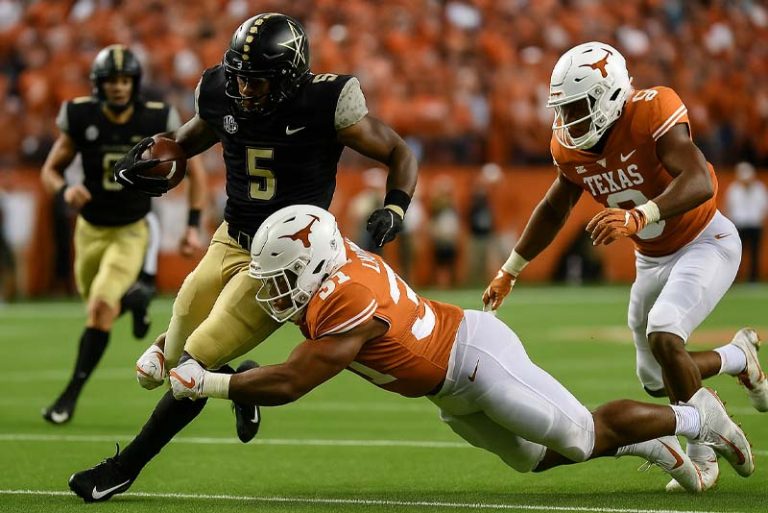
Vanderbilt is currently recording 38.4 points per game, which shows that they have one of the best offenses in the nation. Saturday, November 1, 2025, has two noon kickoffs that highlight college football’s Week 10 —ABC covering Vanderbilt visiting Texas, and FS1 covering West Virginia visiting Houston. Also, the two games are conference identity versus conference identity. The SEC’s physicality is matched up against the Big 12’s speed and space.
However, this week is more than just records. It is about the matchups that show who is legitimate as the calendar approaches November, which is also a key period for anyone using legal college football betting sites. The statistical insights explaining what drives each team, and the results of those numbers when they manifest on the pitch, will be uncovered, as will the practical perspectives available to both bettors and fans, as well as the possible points of momentum change as the postseason approaches.
Now, for the intriguing part- let’s discuss why the results of these early games will be important during bowl season. Based on the results of these games, we will be able to predict what to watch for in these early games and how the results will affect bowl season.
Breaking Down the Core Matchups
This matchup features Vanderbilt vs Texas. This is a confrontation between an SEC team built on balance and a Texas squad defined by top-tier defense. Vanderbilt’s offense scores 38.4 points and gains 433 total yards each game, and Texas’s defense is best at 81 rushing yards and 14.6 points per game, which are 3rd and 10th nationally. Texas’s defense should be able to stop Vanderbilt’s offense’s run game if it is maintained.
The difference here is clear. If Vanderbilt keeps its run game intact, it can force Texas into sustained defensive pressure. If Texas controls the line of scrimmage early, it pushes Vanderbilt to throw more, which may play into Texas’ hands.
Houston’s 7-1 start shows steady efficiency as well as the rest of the conference, while West Virginia’s 2-6, including a 0-4 road record, shows a struggling team. In the balance of production, Houston’s offense scores approximately 29 points and gains 380 yards, which are not explosive numbers but consistent
These matchups show conference signatures on full display. The SEC’s muscle meets the Big 12’s tempo, and the numbers will decide whether control or chaos wins the day.
Reading Between the Numbers
Let’s zoom out. Context always sharpens predictions.
Vanderbilt’s offense is within the top 25 nationally in rushing and total offense, just outside the top 35. Texas is just within the top 20 in total defense and within the top 10 in scoring defense, and sits near the middle nationally on offense. That split defines this game: one team that scores often versus another that prevents almost everything.
Averaging 375 yards per game indicates Texas is higher than the middle nationally on offense. That indicates Texas has not established consistent chunk plays. Vanderbilt’s defense is stingy at 18.8 points allowed per game. This game can hinge on red-zone turnovers and overall efficiency.
Houston–West Virginia: Houston’s attack sits mid-pack nationally, and its defense and special teams have delivered key field-position wins. West Virginia’s offense averages around 20 points and struggles with third-down conversions and giveaways. That is a dangerous mix against a ranked home opponent.
In a larger context, these results may indicate who is prepared for postseason chatter as programs near the college football bowl games. Houston seeks affirmation for its expansion within the Big 12. Vanderbilt seeks to legitimize its place in the upper tier of the SEC. All programs have something to demonstrate to the voters and the oddsmakers.
From a gambling perspective, Vanderbilt has, somewhat quietly, been a covering machine, while Texas has let gamblers down. Even if Houston is anticipated to keep the pace of the game, over- and under-inflated lines, along with a change in motivation and weather, can entice bettors to take underdogs. While stats convey a lot of information, it is the betting lines that reveal the true picture. It is this gap that is the most valuable.
Actionable Angles for Bettors and Fans
Here’s how to translate numbers into takeaways you can actually use.
Verify the spread movement.
Texas began as a slight favorite, at -2.5. Given the efficiency of Vanderbilt’s scoring and the inconsistent offense of Texas, sharp bettors tend to wait to see if public money widens that line. Given the spread record of Vanderbilt, it is worth monitoring.
Analyze the total.
A total of around 45 points indicates confidence in the D. In Texas games, the Under is more frequent due to the pace and discipline of the Texas team, while the offense of Vanderbilt requires the most defensive adjustments. In the game of Houston-West Virginia, lower totals make sense with West Virginia’s scoring woes.
Weigh situational trends.
Texas has only covered a handful of recent games. Vanderbilt’s balance and steady scoring make it reliable. Houston thrives at home; West Virginia struggles away. Identifying which side is due for regression often clarifies the bets.
Factor in injuries and travel.
Fatigue comes in late October and November. The health of the Quarterback and shifts in the weather can tip the line and total. In these cases, make sure to check for last-minute depth chart changes.
Think bigger than one Saturday.
These matchups signify long-term conference trends. The SEC defenses control the power metrics, while the Big 12 teams use tempo. Understanding how those attributes carry over multiple games bolsters predictive line projection for bettors.
The instruments are consistency, context, and timing. Ignore the hype and use metrics that are statistically congruent with success.
Looking Ahead: What These Games Could Signal
If Vanderbilt claims victory in Austin, the narrative shifts completely. That would make the Commodores a dark-horse contender for the SEC East and a genuine threat to receive a coveted bowl game invitation. A road win over Texas would not only validate their offense but would also make them a contender for the top 15 rankings in the country.
If Texas’ defense does indeed hold the offense to the expected total, they will not lose their playoff hopes and championship-caliber status. But another lackluster offensive performance will surely drop them from playoff contention.
For Houston, claiming victory on home turf has a lot of meaning. An 8-1 record would anchor them in the Big 12 race, improve bowl expectations, and create positive recruiting momentum. A loss to a 2-6 opponent will lose all the credibility they have built over the last several months.
Vanderbilt versus Texas should be tight — probably a within a field goal — with defense dominating the second half. Expect Vanderbilt to win 31-28. For Houston against West Virginia, the motivation should help the Cougars with a comfortable 38-17 win.
In the long term, these results shape the perception of intra-conference power dynamics. Should both SEC and Big 12 power programs hold serve, the playoff picture will remain clear. However, if the underdogs manage to pull a win, the markets will swing quickly. In any case, we will see a change in conference championship odds and bowl game projections on bet practitioners.
Expert Betting and Strategy Tips
Start with an evaluation of third-down success rates.
Vanderbilt manages to convert over 50% of their third downs while Texas allows less than 33% of theirs to be converted. This combination usually defines the flow of the game. This measure should be tracked live.
Respect the variance. Home field advantage.
Crowd noise and travel make a considerable difference in conference games. Both Texas and Houston can be said to have a considerable home advantage which will offset smaller statistical differences.
Account for offensive tempo.
Vanderbilt runs around 70 plays a game while Texas runs close to 60. These differences will have an impact on totals. Usually, a slow start will be an advantage to the defensive team.
Use ATS history appropriately.
Vanderbilt has a considerable ATS history, which probably still suggests that the oddsmakers are underestimating the team. This provides contrarian value when public betting leans toward Texas.
Check confidence and momentum.
Ranking top 25 has increased belief in Houston’s locker room. Programs that are confident in their abilities will tend to start strong which is an important factor for first-half bets.
Always confirm lineup news.
A missing defensive starter or last-minute quarterback changes will affect the game in huge ways. Information should come before emotion. Bet after confirming final reports.
Frequently Asked Questions
Q: How to Use Power Rankings for College Football Betting?
A: Power rankings in college football combine team efficiency, strength of schedule, and health. Compare them with posted lines — if your ranking differs significantly from the sportsbook’s, you may have found value.
Q: Why are conference identities important in betting?
A: Conference identities determine styles of play and scoring probabilities. For example, the SEC tends to focus on defense and physical play on the lines, while the Big 12 emphasizes tempo and spacing. This knowledge helps in estimating the expected totals and pace.
Q: What information should I keep track of before betting?
A: Important information to track is injury news, the weather, and late line changes. Those who can place bets quickly are classified as sharp bettors and they place bets based on newly available information which is where the betting value is found.
Q: Is total yardage more predictive than scoring averages?
A: Not necessarily. Total yardage reflects capability, but without scoring in the red zone, the capability remains unutilized in winning. To truly gauge the efficiency of a team, both metrics must be taken into account.
Q: Do ATS trends help predict outcomes?
A: ATS trends reveal a bias, not a prediction. If a team is consistently undervalued in the betting market, it is a sign of how the market views the team. ATS is a betting tool to define pricing parameters and should be used in context.
Q: What is the primary factor affecting totals at this point in the season?
A: The weather and fatigue of the offenses can lead to a decrease in scoring. Be sure to analyze the weather forecast along with the recent pace statistics to evaluate how the weather might influence scoring.
Q: When are upsets likely?
A: Upsets are likely when teams encounter overconfidence or a trap in their scheduling. A stronger team that is expected to win easily will tighten its play and adopt more conservative strategies, which can lead to an upset.
Q: How should I respond to significant line movements on game day?
A: If line movement corresponds to injury news, then it is rational. If it is just public money, betting the other way could be the more valuable proposition.
Final Drive: Lining Up the Next Move
Here’s what sticks after all the stats, matchups, and trends:
- Vanderbilt vs Texas is a litmus test — elite defense against an efficient, balanced offense.
- Houston vs West Virginia showcases Big 12 depth and conference pride, but bettors must weigh motivation and spread inflation.
- Trends favor Vanderbilt’s resilience and Houston’s momentum. Both teams have clear paths to solidify bowl positioning.
- For anyone tracking numbers or odds, these games are crucial calibration points for the final stretch of the season.
It’s another reminder that informed betting beats impulsive betting. Study line moves, trust verified stats, and approach every pick like a portfolio decision.
When you’re ready to put insight into action, check the latest odds at BetNow, compare spreads across authorized platforms, and find your edge before kickoff.

Hilbert Mayer
Sports Writer
Hilbert Mayer is a professional sports writer, betting analyst, and content strategist with over 15 years of experience in the sports industry. Before focusing on sports betting analysis and handicapping, Hilbert worked as a sports writer for various news outlets, covering everything from game recaps to in-depth matchup features. Today, he specializes in MLB, NFL, March Madness, and UFC betting, combining his journalistic background with deep statistical expertise and real-world betting insights. His proven track record, sharp reads, and ability to break down complex matchups make him a trusted voice among both casual bettors and seasoned sharps.
Published on: October 29, 2025
Last updated: October 29, 2025