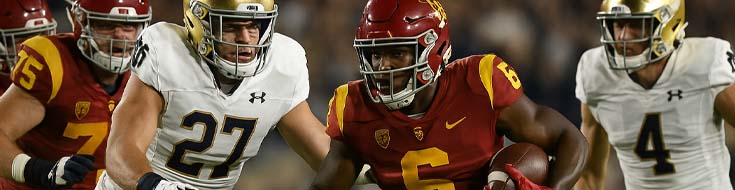
Throughout the history of college football, the Irish have covered the spread five out of the last six home games against the Trojans. Moving into week 8, arguably the biggest games this week feature coast-to-coast rivals USC @ Notre Dame (7:30 ET on NBC) and Utah @ BYU (8:00 ET on FOX), slated for national TV. The importance of these games with respect to rank and perception makes them prime targets for wagering at major college football betting sites.
Each massive rivalry is analyzed in detail to understand which stats, matchups, and correlating theories with real betting lines to make a successful wager (and mitigate losses in in-play sports wagering). Expert insights and foundational questions will also be provided. These games may be separated by thousands of miles, but the rivalry in question is mirrored in all areas.
Rivalry Strength in Numbers
The moment one comes into contact with USC–Notre Dame or Utah–BYU, the first observation would be the significance and weight of the historical context that serves as the foundation for the current precedents set against the backdrop of these rivalries. For instance, the USC–Notre Dame rivalry closely showcases how the home team has gone 9–2 against the spread for the last 11 meetings. According to current market trends, Notre Dame is set to open as a 7.5-point favorite and an over/under of 61.5. The high total points bet likely elicits an expectation of a high-octane offense, with the assumption that USC would not be able to keep pace, especially on the road.
The Volatile Betting Market and the Edge in Rivalry Games
With regard to the Utah–BYU rivalry, the history is also significant, with 62–35–4 Utah’s dominance, but the atmosphere has notably changed. For one, BYU is 6–0 and ranked #15, while Utah is 5–1 and ranked #23. This is reflected in the early lines as Utah has dropped from a –2.5 point to a –3.5 point line. The over/under is also lower than expected at 47.5, indicating the potential of a lower-scoring game.
All of this assumes a game script, pace and the potential for unforced errors. One should especially keep track of line shifts in relation to public money and sharp bets as this provides high predictive power for game outcomes. For instance, in USC–Notre Dame, line movement and closing spread showed an initial public assumption of a stronger line at –9. Additionally, perceived strength matrices were changed with BYU as home underdog for the first time this season.
The neutral or public edges are typically incorporated at early betting volumes. However, rivalry games often defy predictable patterns; you will find late line movement due to breaking injury news or other intel regarding the matchup. Staying prepared requires watching line shifts and implied odds from the betting sites.
Matchup Dynamics in Focus
Let’s break the key matchup levers for each rivalry and how they tilt edge in real time.
USC @ Notre Dame
USC leads the nation with the most efficient offense and the most efficient passing offense under Lincoln Riley, garnering an EPA per play of 1.17. But Notre Dame offers a solid defense and a home crowd atmosphere to counter. The Irish have a strong home ATS record versus USC. However, quarterbacking, turnover differentials, and third-down efficiency will dictate the rhythm of the game. While USC will try to dictate an up-tempo game, Notre Dame will try to slow the game down and win it in structure. The total sits at 61.5, which implies a lean towards offensive performance; however, there is value in the under if USC is unable to sustain scoring drives in an unfriendly environment.
Utah @ BYU
It comes down to Bend and Bachmeier, the mercurial BYU QB and now dual-threat QB, not bad for a freshman. Assignments this week include a dual-threat QB Bachmeier, 1,220 yards so far this season, plus a strong back, LJ Martin, who went for 162 rushing yards against Arizona in a double-overtime win. His pretty down the line RB Utah goes for DB in the warmish off-season and control. Their only sloppy loss in the warm-up season came to Texas Tech. The key for BYU’s offense is to drop Martin down off tackles so they all bumble around BYU’s front 7.
Trojan belief in aggression garnet again. Utah BYU is emotionally charged as much as they go for pace and aggression, more tightly in sync. If a bamble means gain, the Utah-BYU transition will absorb the slack.
Applying Theory to Real Betting
How do you take what you see in stats into actionable moves? I’ll walk through practical steps.
Line Shopping & Variance Buffer
Value can be found on multiple pinnacle MCFB betting sites for spreads, Totals, and props. As always, value can be found within buying and selling MCFB props within variance, even within pairs. This is even more true for the value of rivalry games. When liquidity is low, the value coming from edges can be more pronounced.
Timing entries
For marquee games in the MCFB sport, consider holding off on bet placement for the initial price variables. As news and props develop, lines tend to move. This is certainly true for the over/under lines on the OUSC vs. Notre Dame games. For the Utah vs BYU games, the line certainly moved from -2.5 to -3.5, which shows a higher bet was probably expected in the betting pools coming in.
In Play Betting
In-play betting to cover or leverage a bet where the early line diverges from your line set is a great way to use live sports betting. With early betting on USC, the Notre Dame money line is expected to collapse. This is true for BYU surprise games as well, where the value is certainly opened with a live underdog line on the BYU spots.
Bankroll and prop betting
Due to the emotional outcomes in rivalry games, the shot value on bets in variance is expected to be lower. Increased dependence on props as a higher variance market can be inefficient. For betting, player props, betting within the expected value limits for overtime, and drive length bets are all inefficient and should be avoided.
Value Bias
For rivalry games, sentiment and fandom play a large role in the outcome. As data is agnostic and history is biased, use the data trends and ignore the emotional value in matchups. In-game data, splits, and mismatches should be your pillars.
Looking Ahead: What to Expect
Let’s project outcomes, variance, and championship ripple effects.
In USC @ Notre Dame, a close, high-scoring affair is likely. We Lean: Expect Notre Dame -7 and total 61.5 to hit Over (expect 45–35 or 42–38). USC might struggle a bit under pressure on the road. If Notre Dame covers convincingly, their CFP odds (currently ~24.3%) improve. However, if USC pulls the upset, it would shift narratives and also cause line volatility for the big games.
In Utah @ BYU, we lean: Expect BYU +3.5 or even the under. BYU’s offense has shown explosiveness, and underdog home momentum can flip value. We expect a tighter final (24–21, 27–24). If Utah wins outright, it strengthens its Big 12 positioning. If BYU wins, the emotional victory would communicate a new order in the historic rivalry.
Longer Term: Both games are set to define November matchups and playoff positioning. Post midday lines, betting volume is going to increase, especially in props and live in-game. There are going to be bold bets and the movement in one game is likely to influence sharp action in the others, so it makes sense to monitor these in parallel.
Expert Insights & Tips
Here are key actionable tips — not fluff — drawn from analytics, market behavior, and teaching edge.
Track home team ATS metrics in a rivalry.
Historically, this does matter. For instance, the value of home dogs or slight underdogs can be inferred from USC’s 9–2 ATS record from the past in Notre Dame visitations. Use it as a bias filter, not a rule.
Check early injury/availability reports.
Assessing the impact of late scratches, hidden cross-country travel plans, and weather forecasts can offer a predictive edge on volatile line movements. Get ready to pounce in the 24–12-hour window before kickoff.
Look for “script breaker” player props.
Quarterback rush yards, wide receiver over/unders, and total pass attempts are often mispriced in relation to team props. These are micro-edges to exploit.
Scale into the bet.
Instead of placing the entire size at once, consider breaking it into two or three smaller entries as the odds shift. If it moves against you, pull back.
Live bet as a hedge.
If you’re on the favorite and the game goes sideways, you can hedge or try to reclaim balance with a live underdog or a total bet. But don’t over-hedge — margin erosion is a risk.
Control Emotion.
Rivalries spark fanaticism. Treat every bet as a business decision, not a fan’s desire. Negativity will cloud your judgment and create poor edges.
Frequently Asked Questions
Q: What’s the difference between spread bets and moneylines?
A: Spread betting requires the favored team to win by the point spread or more to secure a win. A moneyline wager simply requires one to pick the winner. Spread bets give margins, while moneyline bets give value to the underdog.
Q: When is the best time to place a bet on rivalry games?
A: It is best to place a bet on rivalry games around 24–48 hours before the scheduled time. This timing allows the betting lines to stabilize while still being able to capture favorable shifts, so avoid first-release and last-minute bets to avoid frenzied betting.
Q: Is value betting on early lines a good strategy?
A: It can be justified if one is trying to exploit a mispriced line. The early betting markets can be described as being unstable and losing players should wait for confirmation before the markets are imploded upon as a volatile prize. IVG
Q: How much of the bankroll should go into rivalry games?
A: Consider laying 2–3% for each bet to keep exposure balanced. With larger most of the dual contests, the variance is higher and one game destroying the entire bankroll is a hazard as 2-3% will avoid large exposure slightly higher variance.
Q: What key advanced metrics should I keep track of?
A: EPA/play, adjusted offensive vs. defensive, turnover margin, explosive plays, and 3rd down splits are the metrics needed to analyze. The metrics mentioned are able to greatly influence the outcome of rivalry games.
Q: Can changes in weather or venue conditions greatly change the lines?
A: It is possible. Wind, temperature, and field conditions are things that can lower or raise passing and running games. If conditions worsen as the game goes on, the totals and over/unders will most likely soften as well.
Q: Should I use contra-public bets (betting against the public)?
A: This can be effective, particularly when the public’s betting tendencies are driven by a fandom bias. Nonetheless, this is not something that should be done blindly. You should evaluate whether public line pressure is a real value or a distortion.
Q: How can bettors enjoy sportsbook prop bets?
A: Sportsbook prop bets are individual player or event bets (e.g. QB rushing yards, total TD passes). They often carry inefficiencies because fewer bettors focus deeply, so sharpers can find value edges if they know player usage, matchup splits, and tendencies.
Rivalry Night Reckoning
Three key takeaways: (1) Rivalry games often defy conventional wisdom — setups matter more than history alone. (2) In-game and prop markets present hidden edges especially if you monitor line moves and matchups. (3) Hanson discipline beats fandom — don’t let the emotion of USC vs Notre Dame or Utah vs BYU cloud your risk management.
These matchups are more than tradition — they’re live betting theaters across coasts. Use what you learn here, stay sharp, and keep scanning the lines and props up through kickoff and beyond. For those ready to act, BetNow offers robust markets for national rivalry showdowns and prop pricing. Let the rivalry heat be your edge — just stay measured and grounded in data.

Hilbert Mayer
Sports Writer
Hilbert Mayer is a professional sports writer, betting analyst, and content strategist with over 15 years of experience in the sports industry. Before focusing on sports betting analysis and handicapping, Hilbert worked as a sports writer for various news outlets, covering everything from game recaps to in-depth matchup features. Today, he specializes in MLB, NFL, March Madness, and UFC betting, combining his journalistic background with deep statistical expertise and real-world betting insights. His proven track record, sharp reads, and ability to break down complex matchups make him a trusted voice among both casual bettors and seasoned sharps.
Published on: October 15, 2025
Last updated: October 18, 2025