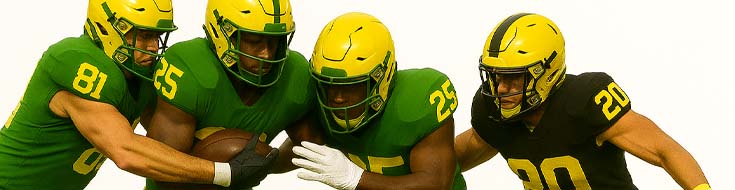
During the last four years, the last eight out of twelve NCAAF matchups between the top 15 teams and unranked teams within the Power conferences have been decided by a single possession. As the season progresses, rankings have shown to be bendable, breakable, and at times meaningless. This range is exactly what makes November football not just interesting, but valuable to bettors who have put in the work studying matchups. November Week 11 takes the November chaos to a national level. No. 6 Oregon travels to Iowa for a Big 10 – Pac 12 crossover on CBS. Later in the evening, No. 12 Virginia hosts Wake Forest in a top ACC contest in which the outcome will heavily influence the conference race.
While neither match proves conference affiliation, they are aligned by the value of roster identity, line dominance, style and pace of play, and field control. All the components necessary to identify the value in offensive efficiency, defensive regression, home field, and situational play–calling divergence. The growth of legalized betting has led to an increasing number of bettors on NCAA football betting platforms, the majority of whom approach Saturdays without a strategically laid plan based on matchup fundamentals rather than brand hate.
Breaking things is what matters. Predicting what will break is a skill.
Anatomy of a Big-Board Matchup: Why do These Two Games Matter More Than the Ratings
Oregon’s Front vs Iowa’s Identity Wall
Oregon operates on the principles of speed and space. They want tempo, explosive plays, and to stretch the field sideline to sideline. They have ranked in the top-12 in yards per play in the last three seasons, while in 2024 they ranked 15th in points per drive. They use formation stress to manipulate defenders out of position and layered schemes (with option plays) to attack open areas.
Iowa exemplifies the opposite. They slow everything down. Small field, tight spacing, defensive play first. Under Kirk Ferentz, they have ranked top-20 in scoring defense in 7 out of the last 10 years. In 2024, Iowa also recorded a defensive metric of holding teams under 5.0 yards per play. It’s not flashy, it’s efficient. Iowa squeezes the game into a low-possession, slugfest.
This isn’t about points. It’s about control. From 2021–2024, Iowa is 24–6 when games stay under 58 possessions. Oregon is 19–4 when they hit 67 or more. As the statistics show, it is the control of the pace that determines the outcome. That is the real battle.
Virginia’s ACC Run vs Wake’s Quiet Upset Math
In terms of Success Rate, Virginia qualified as a top-25 offense for 2024, and in terms of EPA/Play, they were in the top-35 on early downs (CFBD). This was achieved with a compact model. Virginia maintained efficient schedules, avoided negative plays, maintained and advanced drives, and converted on 3rd downs above 42%. This model works. It also frustrates opponents as it never appears explosive, yet its progress seems inevitable.
Wake Forest operates in the disruption zones. Within CFBD for 2024, they were in the top 40 for Havoc Rate (TFLs, PBUs, forced fumbles, INTs, etc.), yet they were also in the bottom 90 for allowing raw yards. This is a reference to the fact that they give up real estate, yet they capture and flip the game in wildly chaotic pockets.
This is the core tension:
- Virginia wins games by remaining completely rational.
- Wake wins games by forcing irrationality.
With respect to the ACC titles, there is a strong correlation between the two. Having one loss on the schedule changes tiebreakers across divisions and places the team on the CFP fringe. This is not a style debate. It is a debate on volatility.
What the Line Won’t Tell You, But the Trenches Will
Public betting lines follow rankings and not the blocking. Betting edges exist within the line splits. For example, when the top-10 teams face physical, disciplined opponents on the road, blind ATS (Against the Spread) results from 2018-2024 show the ranked favorite only covers 46.2% (Action Network historical splits). It drops further when the home team:
- Runs 62%+ of the time under center or heavy personnel
- Ranks top-30 in defensive third-down rate
- Plays in bottom 20 in pace
Iowa checks all three conditions. That doesn’t mean they are the better team; it makes them the harder team to margin.
Wake Forest qualifies differently. Under the dogs who rank top-45 in havoc but outside top-80 in total defense cover historically at 52-55% in prime-time conference road games (Action Network trend data, 2019-2024). Chaos travels better than consistency at night.
This is the statistical framing. Now, we flip it into an application.
Tactical Edges That Actually Matter on Saturday
Situational Pacing Is the Game, Not the Side
Oregon’s offensive coordinator prioritizes efficiency through pace. Conversely, Iowa prioritizes efficiency through the reduction of possessions. Here, it is not a case of ‘which team has the better roster wins’ but rather a ‘clock architecture’ scenario. If Iowa manages to produce at a minimum of two drives of over five minutes during the first half, historical data on similar match-up archetypes suggests that Oregon’s first-half cover probability falls below 40%.
In the case of Virginia and Wake, the pace is of inverse importance. Virginia aims for 66 to 70 plays with a high success rate, whereas Wake requires the drive volatility rather than the drive length. The game begins in the margins: 3rd-and-medium, early down penalties, and hidden yardage. In a game of this nature, it is often the case that a pre-snap structure over-predicts the outcomes than the talent composites.
Red-Zone Math Over Style Points
In 2024, Iowa ranked within the top 20 in red-zone defense, permitting touchdowns in under 55% of stratagems initiated by their opponents. Oregon, in turn, achieved the top 25 in red-zone offense with a touchdown completion rate of 64%. This has been the hinge in other compared instances. Oregon could drop 10% from its baseline TD conversion rate, and Iowa’s scoring models still hold.
Wake Forest in the red-zone comparison has the opposite consistency: the defense remains average (61% TD allowed in 2024). Offense scoring in the majority occurs via the outside breaks, or shot variance, and not within a sustained red zone. Virginia, on the other hand, lives off red-zone reliability. Only in the latter case does sheer systemic tension define the downside and upside path.
Yes, there will be certain calculations and certain tools. Some will look at the sports betting sites for quick odds. Very few will track where TDS turns into. Field goals, and where in between.
Edges People Ignore But Bettors Shouldn’t
- Since 2021, Iowa has had a record of 10-3 in November home games decided by 10 points or fewer.
- Oregon experiences an increase of 17% in offensive penalty rates for games played below 45°F during road games.
- Virginia in 2024 was top-15 nationally in 3rd-and-medium conversion rate.
- Wake Forest allowed 10+ TFLs in 4 of 12 games last season, all losses.
These are the real levers. Not logos. Not narratives. Mechanics. Repeatable variables.
Win Paths and Likelihood Trees
Oregon’s winning chances improve substantially if:
- They achieve in excess of 68 offensive plays
- They score on 3 of 4 opening drives
- The 3rd-down conversion rate for Iowa is 38% or lower
Iowa is likely to win or cover the spread if:
- Both teams have fewer than 58 offensive snaps in total
- 4 or more punts occur in the first 8 possessions of the game
- Oregon’s red-zone TD rate is under 60%
Virginia is likely to win in a blowout if:
- Drives have an average length greater than 6 plays
- There is 1 or fewer total turnovers
- 1st down success rate exceeds 48%
Wake is likely to win if:
- They create 2 or more turnovers
- They generate 7 or more explosive plays over 20 yards
- They have 4 or more red zone opportunities
Expert Betting Lens: Practical, Fast, Actionable
Do not handicap the brand. Handicap the script.
Identity, not rankings, is how the teams win. Before the scripting, write down every team’s pace, leverage, and possession target. Then, pick the side whose script is more achievable. It won’t matter how pretty the script is.
November highlights home efficiency, not talent discrepancies.
Cold weather, travel fatigue, first-half scripting, and cadence noise all contribute to boosting cover rates at home late in the year. Composite roster grades should not be the primary consideration.
Track “conversion leverage points,” not yards.
Third-and-4 to 6 and red-zone TD rates swing games more than total yardage. These points dictate real points versus phantom momentum.
Prime-time underdogs with Havoc upside are risky.
Teams with spike-play disruption travel better at night than efficiency teams. Volatility beats symmetry under lights.
Unders aren’t slow games. They’re contested games.
If both teams field top-30 red-zone defenses, or both offenses are in the methodical category, then the game outcome will be an under, and this will occur without poor quarterback play.
You should always create a loss path before placing a win path bet.
If you cannot give a coherent explanation for how a bet could lose, you are betting a narrative and not a structure.
Frequently Asked Questions
Q: How Do Parlays Work in Sports Betting?
A: Sports betting parlays combine multiple picks into one bet. All legs must hit to win. Higher risk, higher payout. Correlated legs improve edge.
Q: What matters most in Oregon–Iowa?
A: It’s the count of possession along with red-zone conversion splits and the length and sustainment of drives by Iowa. Tempo control equates to control of the outcome probability.
Q: Can Wake Forest actually upset Virginia?
A: This is plausible if the turnover margin is +2 or better with Wake producing 6–8 explosives. It is best to create and thrive off of chaos for a proper pathway.
Q: Should I bet spreads or totals here?
A: In games of stylistic collisions, the totals are more valuable. Spread value is contingent upon pace control rather than simply the talent gap.
Q: Do rankings matter for betting?
A: Only in an indirect way, as biases from the public betting on ranked teams can unevenly inflate betting lines beyond what the matchups would justify.
Q: What’s a hidden edge in cold-weather games?
A: The increase in negative spikes is largely avoidable with the decrease occurring in the road penalty rate, along with passing efficiency.
Q: Are prime-time unders better?
A: Historically, they are. At night, particularly in conference play, defenses become more familiar with the opposing teams, and more defensive recognition occurs.
Q: Bet early or late?
A: Early lines are more reflective of true betting numbers, while late lines have absorbed public bias and media-driven narratives.
Final Whistle, First Edge
Two games, four different types of each, and Saturday filled with possession math and leverage points. For every correlation found, numerous contrasts remained. Oregon–Iowa is tempo vs. resistance, and Wake–Virginia is chaos vs. structure. Each of these games rewards matchup literacy and punishes box-score glancing.
Key takeaways:
- The real spread is the pace.
- The score driver is the red-zone TD rate.
- Late-season games are won by the home identity.
Havoc underdogs travel well at night.
Bet the conditions, not the covers. Build edges pre-kick. If sharper markets, cleaner execution, and better liquidity for college Saturdays are what you’re after, get set up with BetNow before Week 11 goes live.

Hilbert Mayer
Sports Writer
Hilbert Mayer is a professional sports writer, betting analyst, and content strategist with over 15 years of experience in the sports industry. Before focusing on sports betting analysis and handicapping, Hilbert worked as a sports writer for various news outlets, covering everything from game recaps to in-depth matchup features. Today, he specializes in MLB, NFL, March Madness, and UFC betting, combining his journalistic background with deep statistical expertise and real-world betting insights. His proven track record, sharp reads, and ability to break down complex matchups make him a trusted voice among both casual bettors and seasoned sharps.
Published on: November 7, 2025
Last updated: November 8, 2025