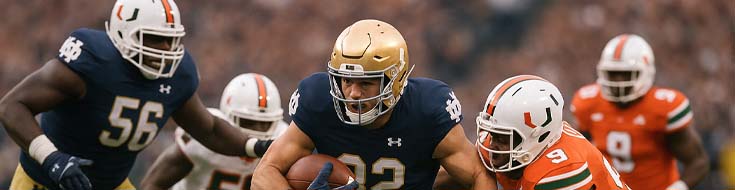
What if I told you sportsbooks are leaning Notre Dame –2.5 heading into Sunday night? That’s the early line across most college football top betting sites. Totals? Floating between 49.5 and 50.5. But here’s the kicker: those numbers are going to move fast, especially when bettors start reacting to that first touchdown or pick-six.
This isn’t just a game between two legacy programs. It’s a live betting opportunity with swing potential on every drive. Most people are just watching. You’re here to find an edge.
You’re about to learn how to dissect live betting value in real time for Notre Dame vs Miami — from reading game tempo and QB rhythm, to fading public reactions and exploiting 2nd-half odds. We’ll cover:
- What the early lines mean — and how they’ll shift mid-game
- How to anticipate live total swings and when to fade momentum
- Why QB performance dictates line reactions
- How to use expert techniques to bet smarter
- Quick answers to real-time betting questions
Let’s get into it.
Game Lines & Public Market Setup
As of Saturday night, here’s where the market stands:
- Spread: Notre Dame favored by 2.5 to 3 points
- Moneyline: ND around –145, Miami at +120
- Total: 49.5 to 50.5 depending on the sportsbook
That book line says one possession, and you’re done. Of course, Notre Dame will get respect from the brand and last year’s playoff. But Miami has a Georgia transfer and most of their offensive line back.
Public perception is definitely skewed. Notre Dame has a far larger national betting fanbase. So, when they score first or get a big turnover, the live lines will move. That is your time to fade the move.
Suppose Notre Dame scores first, and the line leaps from -2.5 to -6.5. Is that line representative of the current state of the game? Most likely not. You are paying an adjustment for emotion and recency. Miami has a comeback mentality — they captured four games last year from a halftime deficit.
What to watch:
- If Miami falls behind in the beginning, just buy them on the alternative live spreads.
- If Notre Dame start slow, don’t panic. Their defense locks up in the last minutes
Stick to strategy, not emotion.
Quarterback Watch: Where Live Odds Miss the Mark
Live changes revolve around Quarterback play. In this case, there are two players to follow:
- CJ Carr (ND) – highly regarded freshman, first career start.
- Carson Beck (Miami) – experienced Georgia transfer, steady under pressure.
If Carr struggles early – a 3-and-out, or worse, a pick in vicious, he’s in big trouble – books will adjust. Carr’s defense gets lucky, but you may find ND at positive or even money odds. They consider this a buy point on Carr.
Reverse it. If Beck comes out hot on his first set and completes 6 passes out of 7, scoring on his second drive, the total increases throughout. Live books, of course, wait until the next drive to adjust player props and team attributes, but that’s the opportunity.
Keep an eye on:
- Tempo – Does Miami’s Quarterback push the pace after a big gain?
- ND’s play calls – Do they run the ball two times in a row after an incomplete pass? That is a sign of little trust in your Quarterback.
If Carr finds his rhythm in the middle of mid game, expect ND and their worn-out defense to push the pace and live totals to go up. I’d hop in on that early.
Game Pace, Live Totals, and Public Overreaction
The totals started at anywhere between 49.5 to 50.5. That’s middle ground — neither a shootout nor a slog. But totals are where the public bias runs wild in rivalry contests.
If Notre Dame breaks a 40-yard run? The total will split the difference and jump 2-3 points just like that. However, that one explosive does not mean consistent scoring, and it’s often scripted.
Live betting strategy:
- Is the total increasing after a big play? Review the play data.
- Is each team gaining greater than 5.5 yards per play? Are the drives long, or is the field position favorable for scoring opportunities?
If drives are stalling in the red zone or defenses are bend-don’t-break holding everything in front, lean Under. Notre Dame allowed only 1.9 red zone TDs per game last season, which was Top 5 in the nation. That stat doesn’t pop up on the broadcasted graphics, but it is still useful.
On the other hand, if both teams are pushing the tempo and scoring more than a “cough and a sneeze”, especially after halftime, look to live Overs. Books are very slow to set the line and keep it until the tempo is sustained for 2 more drives.
This is the core of college football betting: being faster than the algorithm.
Second-Half Adjustments & Projecting Game Flow
Rivalry games all seem to follow their own sequences. For example, during the last 4 matchups played between Notre Dame and Miami, the team losing at halftime managed to cover the 2H spread in 3 games. That ain’t something to dismiss.
How come? Miami comes out of halftime ready to go. Their OC is notorious for scripted third-quarter drives. If they are behind, they go for the focused, no-huddle deal. That signals for the team total Overs or when the next team to score is Miami.
The Fighting Irish tend to slow games down in the second half, particularly when leading. Last season, they were not ranked in the top 80 for second-half tempo when ahead. That creates 2H Unders, mainly if the first half is played at a faster pace.
Aside from the score, why is it so important to understand who has the plan coming out of the half?
The important things to focus on are:
- Injury Reports- especially in the secondary
- Turnovers- Miami was +6 last season
- Defense fatigue- time in possession helps you understand when the corners start to show their weakness
Get ahead of the changes; don’t wait for the announcers to let you know what is going on.
Expert Insights: 6 Practical Live Betting Moves
Skip Ahead the First Touchdown
The first touchdown of the game often comes with a scripted drive. Books and gamblers a little bit crazy. Just mark the next possession and chill.
Bet On Drive Results
Most major books have one or both of the options “Next Drive Result” and “Will This Drive End in a Touchdown” props. If Beck’s in rhythm and Notre Dame’s defense is gassed, there’s a good opportunity.
Look for Signs of Poor Play
If the flags are being thrown or the O-lines are being trampled, bet on drive punts or the Under. Most books now set the pace of the game
Split Bets into Hypotheticals
Don’t attack the investment all at once. Place one-third of the entirety of the stake. Then, wait to see a mistake and place another third. Then wait until the third quarter, and if the wager permits.
Bet On 3rd Down Conversions
Live books hardly adjust for this while the game is in progress. If a team is converting 70% on 3rd and short, place a bet on their total thrust drives. If they are hitting roadblocks, bet less.
Be Aware of Incoming Weather
If clouds begin to form, or there’s a short clip of the ground being wet, there’s a change in strategy you need to make. Notre Dame, for example, focuses more on the run, and that means an under wager.
Frequently Asked Questions
Q: How does live betting work in college football?
A: You’re betting as the game unfolds — lines move based on every possession, injury, and score. Timing and quick decisions are key.
Q: When should I bet a live spread?
A: After a big play or turnover. Lines move hard, and the public chases. That’s when you fade the spike and buy value.
Q: Should I go Over or Under live totals?
A: Depends on pace. Fast tempo and explosive plays mean Over. Long drives and red zone stalls? Bet the Under.
Q: What risks come with live betting?
A: You can overreact or miss your spot. Emotions run high. Stick to unit limits and don’t chase bad entries.
Q: Can I bet drive-by-drive outcomes?
A: Yes. Props like “Result of This Drive” or “Next Team to Score” offer great value if you spot momentum shifts.
Q: How to Bet Over/Under in Bowl Games?
A: Look at opt-outs and coaching changes. Early college football bowl games often lean Under due to conservative play and missing starters. Late bowl games with playoff contenders tend to go Over thanks to aggressive calls and explosive offenses.
Q: Is it better to bet full game or halves?
A: Halves give you clearer windows. If one team adjusts well — like Miami after halftime — target second-half lines.
Q: How do I manage bankroll during a live game?
A: Set limits before kickoff. Use staggered bets. Never chase a bad line. Have your plays mapped before reacting emotionally.
Conclusion
Let’s talk about the key takeaways.
- Saavy money management will show there is profit potential after the new live betting line post on turnovers and key plays.
- The primary concern is the live value created from the rhythm of the quarterback and any coaching changes between possessions. It’s about the tempo, not the score.
- Advanced betting on props and drive outcomes is where the betting lines are weakest. These are your greatest value opportunities.
- Detaching myself from the action is the hardest. Missed opportunities are standard; taking the right action is not.
- You are free to tailor your betting strategy to your preferences. Live props, alerts, line parlaying, and partial cashouts all at one betting site are the advantages. Knowing when to cash in your edge is where the advantage is.
For sharp bettors focused on maximizing value, BetNow will provide high line speeds and deep prop betting flexibility. Bet smarter and faster with BetNow.

Hilbert Mayer
Sports Writer
Hilbert Mayer is a professional sports writer, betting analyst, and content strategist with over 15 years of experience in the sports industry. Before focusing on sports betting analysis and handicapping, Hilbert worked as a sports writer for various news outlets, covering everything from game recaps to in-depth matchup features. Today, he specializes in MLB, NFL, March Madness, and UFC betting, combining his journalistic background with deep statistical expertise and real-world betting insights. His proven track record, sharp reads, and ability to break down complex matchups make him a trusted voice among both casual bettors and seasoned sharps.
Published on: August 31, 2025
Last updated: August 31, 2025