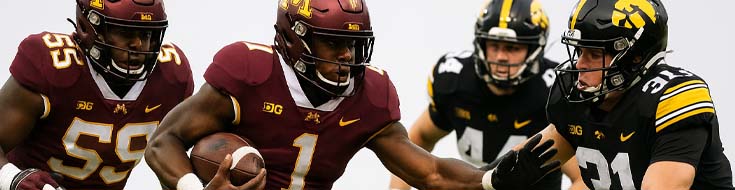
The upcoming playoff matches scheduled for Saturday exemplify the new Big Ten’s pulsations. Saturday’s Minnesota Golden Gophers (5-2) vs Iowa Hawkeyes (5-2) match at 3:30 PM ET (CBS) and the 4:00 PM ET (FS1) Wisconsin Badgers (2-5) vs Oregon Ducks (6-1) conference contest are the two fixtures that most obviously speak to the new conference configuration.
The movement of lines at the online college football sportsbook serves as a snapshot of sportsbook aggression, injuries, and late-week adjustments. Understanding the prism of the Big Ten’s current season will explain the betting spread, the (expected) matchup, and the line movement. Big Ten season forecasting will explain the rationale behind probable mismatches and imbalances in the week’s spread. Understanding the prism of the Big Ten’s current season will explain the betting spread, the (expected) matchup, and the line movement.
The content has been laid out in four layers to ease navigation and increase comprehension.
- Current Momentum and Key Matchups
- Comparative Context and Market Reality
- Actionable Angles for Bettors and Fans
- Forward-Looking Projections and Big Ten Implications
Expert insights, anticipated questions, and a linked summary to BetNow for value betting are provided at the end.
Rivalry Under Pressure: Minnesota’s Air Attack vs Iowa’s Wall
Nothing is more important than the Floyd of Rosedale rivalry in the upper Midwest — especially this year, as it serves as a decider for the Big Ten West. Iowa is coming in with the No. 4-ranked run defense in the nation, accounting for less than 90 yards per game. On the other hand, Minnesota has relied more heavily on quarterback Drake Lindsay, to whom he has thrown for 1,437 yards, 10 touchdowns, and 3 interceptions in 7 games.
An output of 353 yards gained on the ground for Minnesota over the last three games has left the offense, as it were, one-dimensional. As for defense, Minnesota sits 85th overall in red zone defense, permitting 86% of the offense to score when they enter the red zone. 93% of the time, Iowa converts in the red zone, and they certainly relish the opportunity to score this way.
Minnesota has a discipline problem; it averages 33 yards of penalty per game as opposed to Iowa’s mere 21 yards per game, one of the lowest in the FBS. Currently, the odds are in favor of Iowa by 8.5 points.
If Iowa takes care of the ball and dictates the tempo of the game, the Hawkeyes are more likely to cover the spread, with the home support. Minnesota’s realistic shot at an upset is to pass and win the turnover battle.
Two Different Worlds: Comparing the Saturday Showdowns
When placed in comparison, the differences become immediately apparent.
- Minnesota—Iowa: old-school Big Ten football —tight, disciplined, and physical.
- Wisconsin—Oregon: new-era expansion clash — speed vs size, tempo vs time-of-possession.
Oregon’s offense has been a machine, averaging 44 points per game. Wisconsin, by contrast, has managed only 13 per game, ranking near the bottom of the FBS. Strength of schedule matters: Wisconsin’s 2025 slate has been rated the third toughest nationally.
That imbalance explains the spread: Oregon is favored by more than 30 points. For perspective, the Ducks have covered five of their last six, while Wisconsin has failed to cover in four straight.
Context: One matchup (Minnesota/Iowa) feels like a coin flip inside the trenches; the other (Wisconsin/Oregon) looks like a test of survival. Betting-wise, the first is sharper in value; the second is risk management on a heavy favorite.
Turning Numbers into Action: Where Bettors Find Their Edge
If you’re studying lines, here’s what to look for before kickoff:
Minnesota–Iowa:
Iowa’s spread near -8½ means they must win by at least nine. Understanding how point spread works is critical — it measures not who wins, but by how much.
Iowa’s defense and red-zone efficiency perfectly exploit the weaknesses presented by the limited run game of Minnesota. Minnesota’s run game is truly limited, and it’s of great consequence.
Still, the unexpected can always happen. If Lindsay gets going early, the underdog will most likely remain within the touchdown margin.
Wisconsin–Oregon:
This indicates market confidence in the Ducks’ -33 ½ point line and a total close to 44 ½ .
Wisconsin has heretical troubles gaining sustained drives, while Oregon’s defense creates opportunities, ranking in the top 10 for takeaways.
With larger-than-normal point spreads, the Middle can be very profitable. In this case, you would want to wager on Oregon first, and then hedge your bet by betting on Wisconsin live, as most likely the line will inflate during the 2nd quarter.
Finally, in the Oregon game, the weather will also be a factor. Autzen Stadium weather in late October can completely change your total expectations for the game.
In both games, the situational factors are the biggest advantage. Injuries, distance traveled, kickoff time, and fatigue are all reasons the performance changes.
Looking Ahead: What Week 9 Could Signal for the Big Ten
Projecting outcomes means blending numbers with momentum.
Minnesota–Iowa Projection
Anticipate Iowa winning by a score of 24-20, a fraction over the total, while hitting the market projection almost exactly. Iowa’s discipline and defense will give them the edge, but the score will stay close because of Minnesota’s passing offense. There’s a 30 percent chance of an upset.
Wisconsin–Oregon Projection
Oregon should be projected to win 41-7. All models and stats combined give a 97 percent chance of Oregon winning. Wisconsin’s offensive line is still a liability as they allow over 3.5 sacks per game. By the second half, Oregon’s depth and pace will have effectively exhausted them.
Broader Implications
Iowa may take command of the Big Ten West, improving its positioning for the postseason.
Oregon, playing in its first season as a member of the Big Ten, would establish itself as a playoff-caliber program and a credible contender for the East (or cross-division) title.
Wisconsin is undergoing an identity check; Minnesota still controls its path to a bowl game.
Both matchups remind bettors that public perception is the slowest to evolve, and that’s where the most value lies.
Expert Edge: Six Quick Tips for Smarter Bets
Look beyond the box score. Yardage splits and efficiency rates provide more insight than the final score. Iowa’s defensive efficiency also speaks to its success better than its raw totals.
Rivalries close gaps. Emotions shrink spreads. Over the last decade, Minnesota–Iowa has produced a total of six games that were within a single possession.
Be mindful of emotional fatigue. Stretching the Wisconsin region, given their heavy losses, can contribute to a lack of late-game effort, especially when their totals are in the mid-40s.
Just because public money is placed, does not mean it’s sharp money. A 30-point line on Oregon will attract casual bettors; more sophisticated money would be looking at alternate totals or first-half lines.
Pay attention to the line movement. A sudden two-point shift within two hours before the game can suggest sharp money or breaking injury news.
Bankroll discipline can outweigh predictions. Don’t over-leverage on a single Saturday slate. The volatility is especially high during rivalry weeks.
Frequently Asked Questions
Q: What is a point spread?
A: To explain point spreads, we have to take Betting. In a betting scenario, if a team is “favored by -8.5,” that team “must win by nine or more for its backers to cash.” If the underdog “covers” the spread, that team “loses by eight or less or wins outright.”
Q: How do sportsbooks determine totals?
A: They do so by forecasting the scores of both teams, focusing on “pace, efficiency, and weather models” and allowing the market to adjust the figure, either upwards or downwards.
Q: Why are Oregon’s spreads so large?
A: Dominant teams that have elite offenses and greater assaults of space attract enormous engagements. To adjust for this, Oddsmakers “inflate” the lines.
Q: What defines value in betting?
A: Value in betting is defined when the “projected probability beats the implied odds.” For example, you think Iowa wins 70% of the time, but the line implies 60%, which defines “value”.
Q: Should I stick to conference games?
A: Conference familiarity can aid analysis, but the lines also become tighter and sharper.
Q: How much do home-field and crowd noise matter?
A: Quite a lot, especially in places like Kinnick or Autzen, where the crowd influence can “add two to three points to a spread.”
Q: When is the optimal time to place a bet?
A: It can be ‘early’ if you predict the line movement or ‘late’ if you want to wait to gather the latest injury and weather information. A keen bettor will place a bet on the best market line available and not necessarily on the most favorable team to win.
Q: How Sportsbooks Use Psychology to Influence Your Bets?
A: They spotlight favorites, promote trending parlays, and showcase “boosts” that feel like easy money. Those cues steer bettors toward the public side, giving top sportsbooks sites balance and profit.
Final Word: Stakes, Strategy, and the Smart Move
Here’s what matters most heading into Week 9:
- Iowa controls its destiny and remains the most disciplined team in the West.
- Minnesota must find balance; its aerial flashes need complementary ground support.
- Oregon is everything the Big Ten hoped for — fast, physical, and nationally relevant.
- Wisconsin has pride to protect but faces a reality check against a top-five offense.
For bettors, these games show why understanding data, context, and line behavior matters as much as fandom. The online college football sportsbook boards reflect more than odds — they reveal consensus, psychology, and shifting momentum.
If you’re confident in your read, compare numbers, time your move, and check the latest lines at BetNow before kickoff. Week 9 offers two defining Big Ten matchups — one steeped in tradition, the other blazing a new path. Either way, pride and opportunity collide Saturday afternoon.

Hilbert Mayer
Sports Writer
Hilbert Mayer is a professional sports writer, betting analyst, and content strategist with over 15 years of experience in the sports industry. Before focusing on sports betting analysis and handicapping, Hilbert worked as a sports writer for various news outlets, covering everything from game recaps to in-depth matchup features. Today, he specializes in MLB, NFL, March Madness, and UFC betting, combining his journalistic background with deep statistical expertise and real-world betting insights. His proven track record, sharp reads, and ability to break down complex matchups make him a trusted voice among both casual bettors and seasoned sharps.
Published on: October 23, 2025
Last updated: October 25, 2025