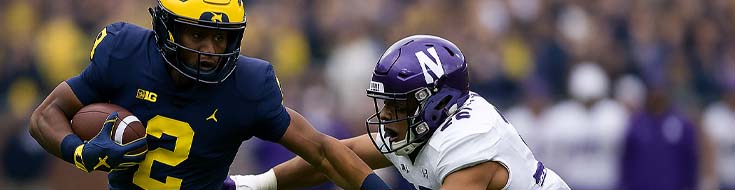
Since 2000, neutral-site college football games average 18% more TV viewership compared to games played at on-campus venues, and Week 12 provides one of the biggest double-dips of the season. At noon ET, Michigan plays Northwestern at Wrigley Field, and for the 3:30 PM contest, Oklahoma visits Tuscaloosa to take on Alabama. These games in particular are catered to a nationwide audience, sizable betting interest, and sharply divided opinions.
For Game one, the betting public is interested in the variables of weather and field conditions, while for Game two, they are interested in the talent on the teams and the national stakes of the game. There is no betting interest on either game from the emotional side, and each contest has edges for those who stay unemotional and work the numbers. If you bet based on the logo, you are late to the game.
These four aspects are what the data indicates, what the matchups mean, and how they dictate outcomes, the practical aspects of the previous two points, and the anticipated market conditions in the next few hours. And yes, provided all conditions are still in line, the whole breakdown would address those working on an online checklist for an NCAA football sportsbook.
Wrigley, Wind, and the Kind of Chaos Michigan Hates
- Michigan (5–5 through Week 11, 2024) has had one of its decade’s most disappointing offensive performances, nearing Week 12 without a bowl game and averaging a mere 20.8 points per game compared to last year’s 36. The run game being 63% of all designed plays, Michigan still nationally ranks in the top 10. The Wolverines, however, seem to have lost their offensive spark. With 4.2 yards per carry, Michigan is statistically in the middle of the Big 10, and their 4.8 starting line is a Big 10 average in the 4.8+ range, suggesting their run performance is below average.
- Northwestern (4–6) plays slow, ugly, and intentionally low-scoring football. Averaging over 32 seconds in between plays, they rank 126th in offensive tempo. In order to decrease the number of opponent possessions and ticking game time, they slow the pace of the game. Betting angles for this game are completely derived from mathematics and not the reputation of the teams involved. Decreasing possessions increases game variance, which raises the likelihood of an upset and allows a large betting favorite to miss the spread.
People downplay the significance of the Wrigley Field factors. The environment is compact. The field of view is broken. Lake Michigan’s wind changes the frequency of passing on low plays. The ball becomes harder to throw during cold weather. Offensively challenged teams—currently, Michigan— lose the small margins they have left. This is not a narrative. Offensively challenged Weather-affected games historically have lower total points by 5 to 7 percent and lift the under hit-rate to over 60 percent when winds surpass 15 mph in outdoor stadiums.
Michigan’s defense may force Northwestern to try and extend drives on third down. This will tilt the game in Michigan’s favor. This season, Michigan is converting third downs at 37%. This is below the national average. Northwestern specializes in these types of game situations. This matchup is quietly schematic dynamite for a game the public assumes is simple.
Oklahoma vs Alabama: Talent Gravity Wins Most Fights
- Even if Alabama (8–2) is not the best version of itself, it’s still Alabama. They find ways to defeat competitors who possess line of scrimmage leverage, even when the secondary gives up yards. The Tide still ranks within the top 15 nationally on explosive runs, averaging 193 rushing yards a game (4.6 YPC), and that remains the same.
- Oklahoma (5–5) is the mirror opposite. They want to game to move sideways, not downhill, and that’s a problem. Relative to the rest of the NCAA, their rushing attack ranks poorly outside the top 100 in EPA per rush. They are primarily reliant on quarterback design runs and short compartment RPO’s which work against average defenses, but it feels like running uphill against Alabama’s front.
A major market killer in this situation is straightforward: Oklahoma cannot sustain drives without explosive plays, yet Alabama at home is not at all generous with explosive plays. While Alabama occasionally gives up big pass plays, for the most part, the defense will allow Oklahoma to gain only 4 or 5 yards at a time. This will starve offenses that lack the willingness or the construction to grind down the field.
Oklahoma’s defense is decent, and red zone efficiency, but red zone stops won’t matter if you rarely force the opponent to have long drives. Alabama scores before defenses are “set” by stacking explosives ahead of pressure. And when that happens, spread lines will inflate, and in-game betting will go from a coin flip to a chess match.
This game has a national audience. ABC audience means peak handle. This means liquidity, and liquidity means smaller edges are discovered and closed much faster. Anyone betting late will need a reason, and that reason will be far from obvious with the broadcast.
Where Theory Meets Reality for Bettors
Most previews fade into background noise at this point; this one won’t.
The Michigan-Northwestern game features low-possession mathematics, environmental disruption, and two restricted passing games. This shifts the spread value to the underdog and the total to under. In contrast, the Oklahoma-Alabama game features larger bodies, deeper rotations, and scoring bursts, but only one side is constructed to sustain the rhythm.
When constructing a board, these two games would not be assigned the same betting strategy. One is a cage fight on ice; the other is a depth chart stress test.
Weather spreads predictability and value, and spread value disappears once beat writer confirmations are released. Sharps hammer totals as temperature and wind updates are released. Lines in Tuscaloosa move based on injury clearance, sudden quarterback clarity, start confirmations, or other surprises.
Even casual bettors have heard the phrase ‘buy the number, not the team.’ But sharp players do more. They analyze possession counts, points per trip, havoc rate, and offensive drive survival, particularly in games with compressed-play volume. This is not theory; it is how to define a 17-10 game before the opening kickoff. And yes, this is where sportsbook betting strategies matter—when your read isn’t emotional, it’s structural.
Projection Without Prediction Theater
Most previews guess the score. This one frames the range.
- Michigan and Northwestern are estimated to finish with a total possession number in the low 40s. This indicates a likely 7-point or fewer margin in score unless there are defensive points. When there are fewer than 45 defensive possession snaps per team, the chance of an upset increases. Missing a tackle or a special teams error becomes far more consequential than usual. From a historical perspective, the most likely outcomes in a game of this style would cluster around 20–17, 17–13, 23–20.
- Oklahoma and Alabama are expected to reach a 60-possession game. Oklahoma has to score 2 or more uncontested touchdowns to stay within the point spread. Alabama has to stay on schedule to score and avoid unforced turnovers. Games around their predicted score of 31-17, 34-20, and 27-13 tend to cluster based on the given turnover distribution.
You should note market shaping by, in no particular order, weather, pace of play, team depth, home field advantage, travel, possession volume, and leverage in the trenches rather than historical brand strength.
Expert Reads That Actually Apply to the Window
Accumulate possessions, not total yards.
Accumulated yards signify little when the game is played at a slower tempo. Possessions provide a clearer indication. Betting should be done on opportunities rather than on the total.
Margins at neutral sites expand the ‘unders’.
Disruptive conditions (slippery surfaces, sight lines, acoustics, etc.) affect high-pressure thirds the most. As evidenced by the expected value, these conditions will likely yield more than the average.
Bets on home-field SEC games still move the lines.
Tuscaloosa isn’t a myth. It is the backdrop of traditional scoring suppression for road teams without top-15 trenches.
Bet on the condition, not the season average.
Michigan’s season PPG or Alabama’s historical résumé gets priced in weeks ago; today’s market reflects current reality.
High variance scenarios favor live betting as opposed to pregame.
If the first pair of drives confirms the expected pace of play, the live total will be more accurate than the opening number.
Injuries don’t provide an edge till the public overreaction.
The value isn’t the announcement; the value is the panicked response by the market in the aftermath.
Frequently Asked Questions
Q: Do neutral-site games benefit underdogs?
A: Certainly, particularly during colder months. With less familiarity, execution drops, and variance increases. Historically, shorter games result in underdogs covering more often.
Q: How do weather elements change totals?
A: Wind, cold temperatures, and hard fields impact deep passing efficiency first and foremost. The markets change quickly, but those reacting quickly are usually the early bettors.
Q: Is betting early better than betting late?
A: Yes, if you have weather, injury, or tempo information early. If you do not have that, waiting keeps you from guessing into line corrections.
Q: Are there situations to avoid betting entirely?
A: Yes. Large uncertainty about quarterback availability, unpredictable weather, or snapping key players.
Q: What stats matter more than points per game?
A: Allowed havoc rate, 3rd down conversion differential, red zone possession %, early down EPA, and defensive line pressure rate.
Q: Does public betting matter?
A: It matters regarding the closing line value. The public shifts lines, not results, and you benefit from their overcorrections.
Q: Can matchup style override raw talent?
A: Yes, in slow games. In fast-paced games with high possession, talent depth almost always retains control.
Q: How Injuries and Team News Influence Sports Betting Markets?
A: They shift spreads instantly, but overreactions create opportunity in sports betting markets. The edge comes when injury impact is smaller than the market assumes.
The Smartest 180 Minutes You Can Spend This Week
Two blueprints, two games. Wind compressed by tempo and volatility calls for a different approach than the leverage, depth, and physical hierarchy of the other. Bet on the same ecosystem, and you’ll lose on both.
Three big takeaways.
- Predictions here are made more accurately by possession than by yardage.
- More than the strategy used, the environment swings between Michigan–Northwestern.
- More than the scheme, depth, and explosives drive Oklahoma–Alabama.
If you plan on betting this weekend, you’ll need angles that lie outside the broadcast booth. Finding sharp money is a game in itself. If you’re locking in positions before kick-off, your workflow should already be open on your NCAA football sportsbook online, lines pulled up, numbers compared, and timing mapped out.
The kick-off is coming. The edge window is coming even faster. Set your board at BetNow.

Hilbert Mayer
Sports Writer
Hilbert Mayer is a professional sports writer, betting analyst, and content strategist with over 15 years of experience in the sports industry. Before focusing on sports betting analysis and handicapping, Hilbert worked as a sports writer for various news outlets, covering everything from game recaps to in-depth matchup features. Today, he specializes in MLB, NFL, March Madness, and UFC betting, combining his journalistic background with deep statistical expertise and real-world betting insights. His proven track record, sharp reads, and ability to break down complex matchups make him a trusted voice among both casual bettors and seasoned sharps.
Published on: November 12, 2025
Last updated: November 16, 2025