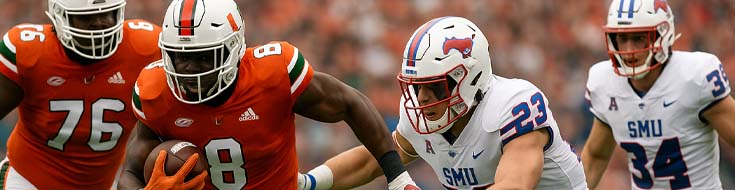
Were you aware that in Week 10 of the 2025 college football season, two markedly different games will be played simultaneously on Saturday at 12:00 PM ET? One of the games includes a top-ten power program, while the other includes a rising conference newcomer. The other game features a service-academy rivalry that has historically endured the test of time. The service-academy rivalry games, as well as the college matchups, draw the attention of bettors looking for a profitable wager on the top-ranked college football betting sites.
- In Week 10 the Miami Hurricanes (6-1) will travel to take on the SMU Mustangs (5-3) as Miami is continuing their chase for the ACC title.
- The Army Black Knights (3-4) travel to take on the Air Force Falcons (2-5) in the Commander-in Chief’s Trophy game, the oldest service-academy rivalry game that will be televised nationally.
- In the following sections you will be presented with a breakdown of the key stats including what they represent, their strategic insights, contextual comparisons for each matchup, theoretical applications you may consider, and predicted outcomes for each game.
Stats That Shape the Story
Miami starts the weekend ranked in the top ten with a near flawless 6-1 record. SMU, 5-3, has just lost a heart-breaking game 13-12 to the Wake Forest Demon Deacons, their first regular-season loss in the ACC.
Taking a closer look, Miami’s QB Carson Beck has thrown for about 1673 yards, 12 touchdowns, and 7 interceptions with a completion rate of almost 72.9%. Their Running Back, Mark Fletcher Jr, has 552 rushing yards in 109 carries and 9 touchdowns. In contrast, SMU’s defense is elite in the red zone — they allow scores on just 64.5% of red-zone possessions for a 3rd place national ranking.
Implications: Even with the versatility of Miami’s offense, they will face stiff competition in SMU’s defense. From a gambling perspective, this indicates Miami is unlikely to achieve a blowout win, despite the odds that will be given. Spread markets will suggest Miami as the leading team, but the real opportunity is in rating how SMU will manage to stay with them and possibly win.
Army, operating a signature triple-option offense, comes in at 3-4. With an average of 36:40, they lead the FBS in time of possession. For Air Force, they are 2-5 and average 33:01 in time of possession (10th nationally) but their red zone defense is porous — they allow 92% of scoring on opponent trips (ranked 119th). In their latest game, the range from the spread data has Army favored by around 1.5 points.
Implications: When two service academies face off, mistakes and execution above all else matter more than sheer talent. Because Air Force struggles inside the red zone, Army may have an edge in finishing drives. For bettors, look at under / over markets and possession-based prop bets — the nature of this rivalry often keeps scores closer than expected.
Context and Contrasts
Miami vs SMU: The way Miami’s players are described shows how Miami sees itself. Beck is characterized as a strong passer, and Fletcher as a hard-working runner, and Miami’s self-assessment includes “pace and yardage”. Conversely, SMU’s emphasis is preemptively on ‘defense’, particularly ‘red-zone defense’, and ‘opportunistic offense’. This emphasis on defense and opportunistic offense is the classic offense-versus-defense dynamic. SMU’s turnover margin is +7, while Miami sits at +5. Turnover margin is often underrated in sportsbook betting strategies.
When those two phases collide, one question stands out: can Miami’s offense execute efficiently inside SMU’s red-zone choke point? If yes, Miami may cover heavily. If not, the Mustangs stay within striking distance.
Army vs Air Force: both teams emphasize control and running the ball more than the majority of programs that run a modern spread offense. However, Air Force’s statistical weaknesses (red zone defense, and allowing 53% 3rd down conversion) exposes them. In contrast, Army has 3rd-down conversions that hover around the 40 percent mark, which is average for the FBS. The context of the Commanders’ Trophy game: weather, altitude at Air Force academy, and that about discipline (penalty yards) are also factors. Air Force averages 40.6 penalty yards per game, Army 24.9 (2nd best) — fewer mistakes may tilt towards Army.
Historical & rivalry context: Miami vs SMU is a relatively new rivalry — but SMU’s move into the ACC raises stakes for both teams. Being top 10 and yet facing SMU at home creates urgency for Miami.
The Army vs Air Force game is steeped in the tradition of the Commander-in-Chief’s Trophy and intangible motivation. It goes beyond the record. This also leads to oddsmakers being conservative with their betting lines. Because of tradition, even a lesser-recorded team can punch above their stats. That context, more than any other, explains the Air Force betting value: don’t dismiss them just because their record says otherwise.
What Bettors Can Use
- During the Miami-SMU game, analyze line shifts and public consensus on wagers at leading college football betting sportsbooks, especially in the opening line for Miami. Should Miami obtain the value and the majority public wager, consider taking value on SMU the underdog and total strategies especially if Miami is still presumed to score quickly.
- Consider props like ‘Miami team total under’ since Miami is likely to have trouble scoring given SMU’s strong redzone defense. When expected scoring margins exceed 10, hedging on the under on team expected points is sensible.
- When looking at props for the Army vs Air Force Falcons game, focus on time-of-possession props in relation to total points under and over. Army possesses the ball for longer and Air Force’s defense concedes a lot of scoring opportunities in the red zone so there is a degree of risk in underestimating total points. Given Army’s predictability, there may be a concession of the points or a small teaser to be expected.
- You should always consider injury reports and impending weather conditions. Weather and the 4th quarter altitude impact of Air Force, the disciplined team (Army) or the under forecasted total is a reasonable prediction.
- Be smart about risk. Use smaller units in betting on either of these games, SMU vs Miami is facing a potential upset, and Air Force vs Army is likely to experience tradition shock; a small unit size is adequate.
Looking Ahead
For Miami vs SMU: Most expect Miami to win but likely by a smaller margin than predicted, about 7 to 10 points compared to the anticipated 14-plus. While Miami’s offensive production should net some yardage, the Mustangs will likely restrict red-zone scoring opportunities while playing at home. Predicting the final sum to score will be in the mid 50’s. Covering the spread will depend on Miami scoring in the first half and turnover prevention. On the other hand, unforced turnovers by SMU increase the chances of an upset.
For Army vs Air Force: Army by a field goal to a touchdown in a lower scoring game would be the projection as well. Data in the total time of possession favors the Army. However, discipline in the offense will make it competitive as well as the high rivalry performance increase. A total under 50 could be predicted. For bettors regarding Army, the best value is in picking Army +1.5 or the moneyline, and under/over props around possession or first-half lead.
For both matchups and the long term, bettors find value when they look beyond win-loss records and focus on underlying situational stats. This is especially true within the top-tier high-rank college football betting sites that track film line movement and public skew.
Expert Insights
- The margin of turnover is more significant than total yardage. Teams with +5 or higher turnover differentials tend to win more often. In 2025, both Miami and SMU have that, which is an advantage compared to their peers.
- Performance in the red zone is one of the best predictors of winning close contests. The fact that SMU ranks 3rd in red-zone defense is an invaluable asset. Regarding the match-up between Army and Air Force, the latter’s red-zone deficiencies of allowing 92 percent of drives to end in scores is a significant liability.
- In regards to time of possession, Army’s 36:40 average for time of possession means Army is likely to dictate tempo which is likely to lower the betting total. This is likely because time of possession is more influential on betting lines than people realize.
- In games such as the Army-Air Force match up, integration of motivation and tradition is key for understanding form. This is an example of a situation where the provided record does not tell the full story.
- The situational context, as well as home-field, add and take away value. The ranked game pressure adds pressure to Miami, during their away game to SMU that hosted them.
- Always synthesize with props or adjust unit sizing for betting on games with mismatches. Factors such as defining rivalries or a stark contrast in playing style like seen with Miami’s offense and SMU’s defense, offset the value in secondary markets.
Frequently Asked Questions
Q: How do sportsbooks set and adjust odds?
A: Sportsbooks use data and models to create sportsbook online odds, then adjust them based on betting action — if one side draws heavy money, the odds shift to balance risk.
Q: What does turnover margin tell us in college football?
A: Turnover margin captures how many more turnovers a team forces compared to the number of their own turnovers the team commits. A positive margin indicates a strong likelihood to win the game because that team has more possessions to score and the opponent has fewer opportunities to score.
Q: Why is red-zone efficiency important for bettors?
A: Teams might gain a lot of yards in between the 20s, but scoring in the red zone is what ultimately helps you win close games. If a team is able to consistently score in a high percentage of their red zone opportunities, or if they are able to defend the red zone well, that is predictive.
Q: How should time‐of‐possession stats influence betting strategy?
A: A team that is dominating time-of-possession is more likely to control the pace of the game, run more scoring plays, tire out their opponent, and ultimately limit scoring. This will translate to a lower final score, and bettors might want to consider betting on the score-limiting team.
Q: How do rivalry games differ in betting from regular matchups?
A: Rivalries make players exert greater effort and reduce the influence of form. This leads to inverse emotional and pressure effects, greater likelihood of upsets, and overall more predictive failure on traditional models.
Q: When should I use props instead of moneyline/spread bets?
A: When certain matchup tendencies are extreme (for example, time of possession, red-zone defense). Props allow you to focus on specific aspects of the game instead of the overall game outcome. In uneven favoritism situations, sportsbook props are usually more advantageous.
Q: What risk do bettors face when chasing favorites?
A: Favored bias causes sportsbooks to inflate their betting lines. If the public bets on a side too heavily and the odds shift generously, expected value will lose its edge. Overconfidence and distraction in the game, as well as other matchup issues, may lead to underperformance by the favorite.
Q: How can injury/venue/context affect betting on these games?
A: Losing a key player (QB, defender) tends to dramatically shift odds. Certain venue elements can amplify effects, such as rivalries, a flight from Miami to Dallas, and altitude (Air Force). Good bettors use context-shifts along with the game’s raw stats.
The Stakes You Can Play On
Here are your takeaways:
- Miami vs SMU features a modern power (Miami) against a defensively efficient host (SMU). Expect Miami to win, but don’t expect a blowout. The value may be in keeping SMU close or buying the under on Miami’s margin.
- Army vs Air Force is less about records and more about discipline, clock control, and rivalry drive. The Army holds a slight edge, but the Air Force could make it tight.
- Use the high-rank college football betting sites to monitor line movement, public betting percentages and collate all the above situational stats.
- Props and context (red-zone defense, turnovers, time of possession) may offer better value than traditional spread bets.
- These games are about matchups as much as rankings — focus on style, not just win-loss records.
If you’re ready to take action, check lines early, hedge appropriately, and use what you’ve learned. Head to BetNow and you’ll be ready with strategy, stats and context.

Hilbert Mayer
Sports Writer
Hilbert Mayer is a professional sports writer, betting analyst, and content strategist with over 15 years of experience in the sports industry. Before focusing on sports betting analysis and handicapping, Hilbert worked as a sports writer for various news outlets, covering everything from game recaps to in-depth matchup features. Today, he specializes in MLB, NFL, March Madness, and UFC betting, combining his journalistic background with deep statistical expertise and real-world betting insights. His proven track record, sharp reads, and ability to break down complex matchups make him a trusted voice among both casual bettors and seasoned sharps.
Published on: October 28, 2025
Last updated: October 29, 2025