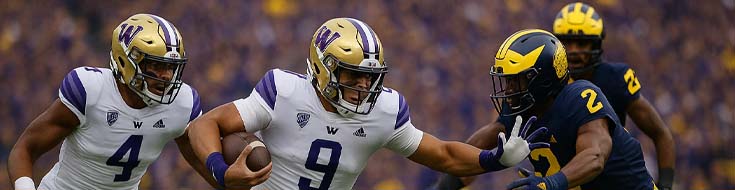
Did you know Washington ranks sixth in the FBS offense’s third-down conversion rate (54.4 %), while Michigan sits 71st on defense, allowing 37.6 % conversions? Those numbers matter when two of the conference’s heavyweight programs meet in Week 8. And for bettors looking to capitalize, identifying the best college football sportsbook is critical to locking in sharp odds and favorable lines.
This week, attention shifts to two marquee Big 10 matchups: Washington at Michigan (12:00 PM ET, FOX) and Ohio State at Wisconsin (3:30 PM ET, CBS). These matchups are more than just rivalry games; they are critical moves on the Big 10 chessboard, with playoff positioning, seeding, and the respective programs’ momentum on the line.
Each matchup will be analyzed thoroughly. Strengths and weaknesses of the teams, betting angles (including live betting scenarios), and key match events are all considered. This will be approached through three key areas: what the statistics say, how they compare to other games, and what the play options are. We will also give predictions on outcomes. Expert insights, a FAQs section, and analysis pre and post to BetNow will also be provided.
The Huskies vs. Wolverines: Tactical Clash Under the Lights
Efficiency Margins and Impact Plays
Washington’s offense has converted over half of their third downs, demonstrating efficiency. Michigan’s defense is vulnerable in this area. Furthermore, Michigan has a +6 top turnover margin, ranked 8th in the nation, while Washington is +5 and 20th in the FBS. Turnovers will certainly be a battleground.
When looking at time of possession, Michigan is lighter at about 28:23 while Washington has the control of the clock at 30:50. The difference in discipline regarding penalties also favors Michigan, who has approximately 38 penalty yards (19th in FBS) while Washington gives up ~57.5 penalty yards (83rd in FBS) . A single, poorly timed penalty could swing field position in tightly contested phases of the game.
- If Washington can sustain their drives by converting on their third downs, get Michigan into third-and-long situations, and avoids turnovers, they can stress Michigan’s defense. However, Michigan can counter this by forcing negative plays, applying pressure on the quarterback, and getting Washington off schedule. The margin between the two teams is thin.
Style and Context Compared
Running Back Justice Haynes (705 rush yards, 8 TDs in five matches) & Quarterback Bryce Underwood (1210 yards, 5 TDs, 2 INTs) drive Michigan’s offense. Because of their mixture of strategies, they have the freedom to choose. Nevertheless, the Wolverines recently lost to USC, 31–13, which illustrated the weak points in their passing game.
Washington’s Quarterback, Demond Williams Jr,. is effective (1200 yards, 8 TDs, 1 INT) and also scored in the rush, and Running Back Jonah Coleman is a good contributor (474 rush yards, 10 TDs in five matches). Because of their balance, the offense is pro-style, which is designed by Jedd Fisch, who is very respected in the field. Additionally, Washington is motivated by their recent comeback win over Maryland.
Washington’s Ryan Walters (1st yr) defense uses 4-2-5 patterns and has done well avoiding giving up the “big play” recently. Michigan’s defensive front is good, but in some contests, they have demonstrated a lack of resistance, especially in the match when their opponents directly attacked the defense lines. Inability to convert defensive third downs is a primary defensive weakness.
Washington is a significant danger, especially if they can execute their game plan on third downs. However, Michigan’s defense is good. On offense, Michigan is very strong and will attempt to exploit Washington’s weakness.
Buckeyes at Badgers: Tradition vs. Turbulence
Ohio State’s Offensive Force vs. Wisconsin’s Struggles
Ohio State is undefeated (6–0, 3–0 Big Ten) and is performing well on both sides of the ball. They have approximately 445.8 total yards per game with 181 rushing yards and 264 passing yards. They have a 50% conversion rate on third downs (19-of-38). On the defensive side, they have throttled opponents and have only surrendered 5.5 points a game.
Free fall describes Wisconsin perfectly. They have been shut out 37–0 by Iowa, marking their fourth consecutive loss. The Badgers also lost starting QB Billy Edwards Jr., and the unwilling backups have been underperforming. Their defensive and morale systems seem to be low, and that includes coach Luke Fickell, who has publicly confessed to feeling “dumbfounded” by their unexpected performances.
Oddsmakers can pick OSU as 28.5-point favorites, which is massive for a Big 10 road game. Wisconsin’s lack of offensive productivity and injuries are making the Badgers soft targets for the Buckeyes’ versatile offense.
Context, Trends, & Risks
Ohio State employs a spread-option offense system while incorporating elements of power football. With receiver Jeremiah Smith and safety Caleb Downs, the offense can be very versatile and multifaceted. Ohio State also seems able to punish opponents’ mistakes, as seen in recent victories, by scoring off turnovers.
There are gasps for answers within the Wisconsin defense, which was formally successful under Fickell. Wisconsin is vulnerable to weak interior run defense and, therefore, vulnerable to OSU rushing attack success. Additionally, mistakes in field position and special teams can be very costly.
Risk: With predominant favoritism, OSU may become complacent, try to ‘run clock’ and avoid attacking, or over-focus and allow turnovers or injuries to occur. However, the current Wisconsin form dictates that these risks will be minimal.
Putting It Into Play
Washington–Michigan Angle
Third-down scripts: Conceding frequently gives Washington life. Bet over/under on third-down conversions; “Washington Third-Down Over.”
Turnover props: With both teams strong within the margin, a takeaway prop (i.e. Michigan + Washington turnovers over a threshold) holds value.
Live sports betting angle: If Washington starts slow but keeps drives alive, odds are likely to shift midgame; a deep strike or sustained drive could swing the live lines. For bettors, monitoring third-down conversions and explosive plays is crucial in the first half.
Spread vs. moneyline: In all likelihood, Michigan opens -5.5. Should Washington come closer, the moneyline value will shift, and contingent bets will pay.
OSU–Wisconsin Angle
- Big spread edge: 28.5 is extremely large; bettors might consider OSU minus points, but alternative spreads (−30, −32) or teasers could offer more value.
- Over/under on total points: OSU’s defensive prowess will likely ensure a lower scoring second half, likely trending the total down.
- Wisconsin desperation live bet: If Wisconsin is trailing significantly late in the game, they may initiate an aggressive (long pass) strategy, which will create likely opportunities for OSU interceptions or punts — live betting on these swings could prove advantageous.
Projection Zone: What Likely Happens
Washington @ Michigan
Lean Michigan 27, Washington 24. This game will be a nail-biter for sure; these two teams have very close levels of talent. The home crowd in Michigan, paired with a running game, a disciplined penalty routine, and superior game discipline, will break out to a small Michigan lead. If Washington comes out with a couple of easy passes and sustains a few drives, they may be able to run the clock and escape with a surprise victory. This game will be close the entire way, down to the final one-score margin.
Ohio State @ Wisconsin
Ohio State triumphs comfortably, predicted already at 38-10. Expect the Buckeyes to win the time of possession, turnover the game multiple times, and have a major lead within the first two quarters. Wisconsin might score a soft touchdown in the last couple of minutes, but the game will be out of reach by that time. The predicted score won’t be that close, and the spread will cover easily.
Also, look ahead. Michigan, if it wins, must itself avoid slipups to remain in the playoff conversation. This will allow Washington to remain in the hunt. For OSU, a blowout will add a margin for tiebreakers, and scoring a running-OSU- Wisconsin will be a bad look on Fickell.
Expert Insights: Tips You Can Use
Don’t overreact to first-quarter lines
Lines following first-quarter results can frequently change. If you notice movements after the first quarter, particularly with third-down conversions or takeaways, you should take advantage of that movement.
Evaluate situational metrics, not just totals
When teams are closely matched in power, metrics like third-down conversions, line-of-scrimmage success, and red-zone efficiency hold greater significance than total yardage.
Employ correlated prop pairings
When you bet on “Washington to convert over 2.5 third downs,” also consider “Washington first-half total points over” to increase odds. If they are sustaining drives, both wagers are likely to hit.
Patience vs. action with live bets
Avoid jumping in early with “live sports betting.” Wait for more established betting patterns (defensive weakening, fatigue) and take advantage of mid-game secondary line swings.
Adjust scenario-based betting toward your “leans”
When Michigan has an early lead, turn to prop markets like expecting a Washington comeback, instead of large spread betting in the direction of Michigan.
Recognize imbalanced coaching shifts
Washington’s Fisch adapts; OSU’s Day controls. If a team significantly alters tempo or playcalling mid-game, that’s an ideal time to adjust bets, especially in live betting.
Frequently Asked Questions
Q: What is contributing to the Big Ten’s competitiveness this season?
A: The competitiveness this season is a result of the depth in the league, the number of teams able to pull off upset wins, and the strong performances in nonconference play. While Ohio State and Michigan are the top teams, the challenge posed by Indiana and Illinois ensures the competitiveness of the league.
Q: How should bettors assess home-field advantage in Big Ten games?
A: Home-field advantage should be considered because of the influence of the crowd, the stress of travel, and the impact of familiarity when the games are close. A home-field advantage of 1.5 to 3 points should be considered when constructing a spread.
Q: Is a heavily favored play safe? (e.g. OSU –28.5)
A: Nothing is guaranteed when betting. Big favorites will invite betting dollars and will drift or invite momentum swings. Always consider alternate spreads, side props, and hedges.
Q: What is the best time to bet for these matchups?
A: Bettors should look to bet when lines are first opened (Tuesday to Thursday) to find the best value, as lines will be skewed by public betting. Bettors should pay attention to reactions to scrimmage games and injury reports, as these will change betting lines.
Q: Does betting the total (over/under) make sense for these games?
A: Bettors should consider betting the total, especially when the games are mismatches. Washington-Michigan will likely lean over the total, while OSU-Wisconsin will likely lean under in the 2nd half. The focus should be on the scoring runs, the exhaustion of the defense, and adjustments made at halftime.
Q: How much should I wager on these matchups?
A: Stick with flat unit sizing (e.g., 1-3% of bankroll) unless you have a strong conviction in a particular matchup. Don’t overleverage bets on big spreads or bets influenced by “home-team bias”.
Q: Are hedge or middle bets possible here?
A: They are. If you early bet OSU –28.5, you can hedge with an alternate spread or moneyline if the line moves. In Washington–Michigan, you might middle between Michigan –5.5 and Washington plus lines later.
Q: How to Develop a Winning Strategy in Sports Betting?
A: For sport betting strategies, always start with trustworthy licensed sportsbooks, size bets within your bankroll, use correlations (e.g. tie scoring props to drives), diversify between spread and prop plays, and factor in A: California-specific rules (taxes, restrictions). Also monitor odds across multiple books to exploit inefficiencies.
Key Takeaways & Action
Here’s what to hold onto — Washington’s offensive efficiency and Michigan’s turnover strength make that clash razor-close. OSU’s dominance meets a Wisconsin team in crisis. Use prop angles, live betting nuances, and scenario-based bets — not blind spread chasing. Seeking the best college football sportsbook ensures you get sharp lines, reliable markets, and smooth execution.
If you’re ready to act, check lines early, lock in value on third-down or turnover markets, and watch midgame for shifts. BetNow is currently offering competitive spreads and prop liquidity — worth verifying your odds there. Lock your bets, stay sharp, and enjoy two of the most heated Big 10 battles this season.

Hilbert Mayer
Sports Writer
Hilbert Mayer is a professional sports writer, betting analyst, and content strategist with over 15 years of experience in the sports industry. Before focusing on sports betting analysis and handicapping, Hilbert worked as a sports writer for various news outlets, covering everything from game recaps to in-depth matchup features. Today, he specializes in MLB, NFL, March Madness, and UFC betting, combining his journalistic background with deep statistical expertise and real-world betting insights. His proven track record, sharp reads, and ability to break down complex matchups make him a trusted voice among both casual bettors and seasoned sharps.
Published on: October 13, 2025
Last updated: October 14, 2025