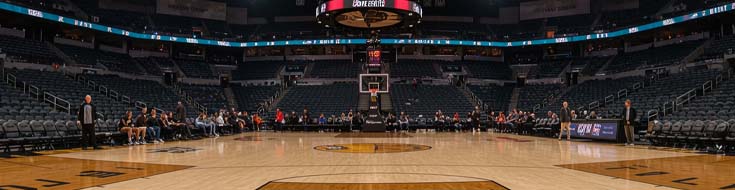
Several teams have already started to make adjustments to their strategies as the men’s college basketball season has just started. Houston earned itself the top position as Arizona quickly jumped into the few spots just beneath. With the preseason rankings already showing their weaknesses, several teams will be looking to make adjustments as there are organized events and betting lines changing frequently. Using the top college basketball sportsbook will assist in creating the best opportunities.
Here are some of the major points of this breakdown:
- The reason for the volatility in rankings this season and its influence on the betting markets
- The impact of the key events in November on each team’s betting profile
- Immediate actionable insights for betting marketers
- Predictions for the next rankings update in December
- Tips to optimize betting for the start of the season
- Insights on timing, strategy, risks, and possible roster changes
- Summary of the main points
Shifting Hierarchies: What the Rankings Reveal
The preseason predicted ranking for Purdue was first, but that was changed quickly with the first few games. Houston rose to the top of the AP rankings after early games due to strong defensive performances and effective, clean play. Arizona was also predicted to be a top 10 team, but after a big win over a top program, they rose to the top 5. Multiple top-15-ranked teams also struggled to win their games, particularly as they were unranked and heavily spread. This placed teams lower in rankings and expanded the range of trends for the season.
What is the importance of this? It takes longer for voters to change within the top 25, so their research is also in the best for sportsbooks. A team that loses early is capable of quickly gaining lower odds to win their conference or for a deep tournament run. Conversely, when a team is outperforming lower expectations, the odds tend to rapidly change in a much lower range. This helps bettors who tend to follow AP Movement weekly, as they get a jump on line changes a few days out of the entire public range.
By mid-November, a few teams are obvious that they are going to be sustainable for the rest of the season, and that is evident in the data. The teams with returning production are outperforming teams that are relying on new transfers to come in and make an instant impact. The programs that are vetted are in the lead on actively covering the spread.
Tournament Pressure: Where Early Edges Actually Form
Non-conference tournaments are always a gamble, but this season we’re seeing their impact on the national ranking picture much sooner than usual. Top-25 teams are participating in events such as the Players Era Festival, the Maui Invitational, and the early Thanksgiving showcases. Neutral-site venues, quirky scheduling, and short turnaround times expose weaknesses much more than home games and provide challenges for teams.
Tournaments are showing elite defensive teams, with unproven offenses, struggling. This has been the case in the past as well, and we’re seeing some of the same patterns. In these tournaments, slow-paced teams tend to get squeezed more. This is especially the case when a team plays on consecutive days. Freshman-heavy teams tend to experience volatility in the second game of the tournament as well. A single missing key rotation player can change the rebounding dynamics and impact the team’s total.
This stretch is critical due to timing. Every year in early November, books will incorrectly price games with freshmen, transfers, and newcomers to the roster. Once those teams start getting games in the tournaments, models update, and the value gap closes. Bettors who watch the tournaments, as opposed to just the scoreboards, have context that the numbers alone do not provide. For instance, teams that are winning games by slim margins while shooting poorly are far more likely to be positioned better for success in the future than teams that win by large margins but are playing weak competition. This valuable distinction is particularly useful in December for betting.
Where Bettors Should Strike: Turning Insights Into Edges
To capitalize on early-season volatility, it is most important to get the timing right. The futures market is mostly soft for the first three weeks. When a team is predicted to dominate but is having a tough start, this creates a window, provided its underlying numbers still hold up.
Consistent strong defensive efficiency (even in close wins), rebounding, and turnover control are what to look out for. Those teams may be close to rebounding, but their odds can drift enough to allow for value betting.
Next are evenly-matched neutral-site games. Teams that perform well in these matchups without the home court energy and comfort are strong bets down the line in conference play. Their performance consistency is indicative of that style setting in a tournament.
There are also great edges in the player props market. Players (especially transfers) getting extended minutes early in the season are often underestimated. Books can be slow to adjust props to new players, especially for rebounds, assists, and three-pointers, until a 5 or 6-game sample is hit. For game totals, look for pace mismatches. In tournaments, high-tempo teams can force slow teams into uncomfortable game rhythms, which can lead to either very high or very low point totals.
Finally, continue to monitor injury news in this period. Missing players can often lead to insights on undervalued bench players when they have props that are being improperly estimated. Early-season rotational changes will give you more insights into a team’s ceiling than later-season blowouts will.
What’s Coming: Forecasting the Next Phase of NCAAB
Looking at the future schedule, the next wave of impactful non-conference matchups will start to define the tiers of teams. Those that will be able to win consistently outside of home courts, while also remaining efficient at neutral-site contests, will solidify a top-10 status. Those that struggle with turnovers and that score a large share of their points from one individual will be at risk of dropping as opponents work their way to a scouting report.
Expect the AP Poll to shake again before the end of December. It is a common trend that at least two teams ranked initially outside the top-15 break into the top-10 by early December. Mid-major programs that gain significant victories early in the tournament will gain a boost in visibility, which will also alter betting lines, regardless of their efficiency.
Betting lines will tighten by mid-December. This is the time to find betting edges. The time window of Thanksgiving week and December 15 is the time window of the season to find edges. These patterns create actionable value, especially for bettors using March Madness betting sites deeper into the season.
Expert Insights
Early Tracking of AP Movement
Movement in polls will be quicker during this time of year. When a particular team moves up or down the polls significantly, expect the market to move in conjunction within a week or so. Bettors who are able to anticipate this movement in the market will be able to move the line in their favor before the market corrections are made.
Focus On Non-Home Neutral Sites
Recognize that not all teams are the same when it comes to the postseason. Some teams have a greater ability to adapt to different environments, especially when it comes to post-season tournaments that are held in neutral environments.
Account For Returning Production First
Teams that have a strong core of returning players will always start the season off stronger than teams that have a lot of new players. Early-season games are crucial when it comes to determining the outcome of the season.
Tracking Bench Minutes in November
Deeper benches are extremely crucial when it comes to tournaments. Teams that have a deeper bench will be able to win tournaments more easily, which will always be a prop to the totals.
Avoid Overreacting After One Bad Game
When a top team plays poorly in a game, it should not be viewed as a collapse of the team. More specifically, it should not be viewed as a collapse if their shooting percentage is low, especially if their shot quality is low.
Avoid Fading Underrated Mid Majors
Underrated mid-major teams will usually be the cause of upsets during this time of year. More specifically, they will be the cause of upsets during November. Expect them to be live underdogs in the early parts of the tournaments.
Frequently Asked Questions
Q: In what way do in-season rankings affect betting value?
A: Rankings influence what people think, which in turn should affect the betting lines. If a team goes up in the rankings, they tend to get overvalued, while a team dropping in rankings that people think should be good could be a good value. You get the betting edge when you bet before the lines change.
Q: What is the significance of early-season tournaments to sports betting?
A: They show you how teams do when they don’t have home court advantage, when they have a short break, and when they play good teams. Weaknesses get exposed in those scenarios, and in those situations, teams are often weak.
Q: What is the impact of new players on a team to start the season?
A: If a team has heavy transfer activity, it can be tough to find a rhythm, creating betting volatility and slowing sportsbooks’ adjustments to the team’s changes.
Q: How Team Roster Changes Affect In-Play College Basketball Betting?
A: In college basketball live betting, in-play odds react sharply to lineup swings. New starters, foul trouble, or inexperienced bench players create unpredictable patterns. Early in the season, these changes alter momentum more dramatically.
Q: Should I bet futures early or wait for more data?
A: Early futures betting gives you the best prices but the most risk. Usually, the best strategy is to take a middle ground and make small bets early, and add more as time goes by.
Q: What risks should bettors watch for in November?
A: November is going to be chock full of small sample sizes, resulting in skews. Ignoring important transactions for teams and betting on preseason projections are all going to be big problems. Especially early in the season, context is going to be very important.
Q: Are totals and props reliable during this early part of the season?
A: Totals and props are even more reliable during this part of the season. This is when books have the least data to work off of, especially with things like totals that are very pace-dependent, or player props that might have soaring usage projections.
Q: How should I evaluate non-conference results?
A: Non-conference results should be seen as result indicators. It is a much bigger indicator of a strong team if they get a win against a strong, competitive team, as opposed to an unchallenging low-tier team. This should guide you in terms of betting for the future.
Momentum Shift: What Smart Bettors Should Do Next
We’re seeing real movement this season already: top-ranked teams flipping positions, early tournaments exposing strengths and flaws, and sportsbooks adjusting faster than usual. If you’re using a top college basketball sportsbook, now is the moment to act—before December’s lines tighten and market inefficiencies shrink. Track early-season metrics, stay on top of roster adjustments, and use tournament performance as your compass for futures and props. Opportunities won’t be this soft again until March.
If you want to lock in value while it’s still available, head over to BetNow and start building your early-season card before the next wave of line movement hits.

Hilbert Mayer
Sports Writer
Hilbert Mayer is a professional sports writer, betting analyst, and content strategist with over 15 years of experience in the sports industry. Before focusing on sports betting analysis and handicapping, Hilbert worked as a sports writer for various news outlets, covering everything from game recaps to in-depth matchup features. Today, he specializes in MLB, NFL, March Madness, and UFC betting, combining his journalistic background with deep statistical expertise and real-world betting insights. His proven track record, sharp reads, and ability to break down complex matchups make him a trusted voice among both casual bettors and seasoned sharps.
Published on: November 24, 2025
Last updated: November 24, 2025