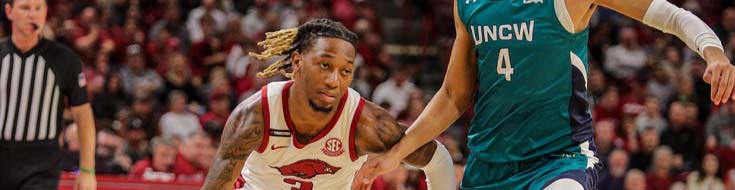
The Sweet Sixteen eludes over 70% of NCAA Division I men’s teams. But already, college basketball betting websites have important lines for the first week of the 2025-26 season, which begins on November 3. There is no question that it will be a season with high stakes and high demand. You will find out the information on the leading title contenders, the most overrated and underperforming teams, and, most critically, the appropriate value in futures markets.
We will analyze the contender tiers, discuss the most important and most unequal conference matchups, and explain how early betting opportunities will be available before lines become efficient. Let’s outline the model.
Elite Tier: Immediate Title Threats
The elite tier comprises those teams likely to combine returning star talent, proven depth, and favorable schedules. At the top, the Houston Cougars are being positioned as No. 1 in multiple early predictions, in part due to their recent reputation from two deep tournament runs and their strong incoming class. The Purdue Boilermakers currently hold the No. 2 spot largely due to senior guards Braden Smith and Trey Kaufman-Renn.
Statistically, these programs also dominate early-season predictions and benefit from solidifying their seeds early due to favorable non-conference schedules. Purdue’s non-conference schedule does include a marquee non-conference game against Auburn, whereas Houston plays several top-50 teams that will test Houston’s defensive efficiency.
What does this mean for bettors? These programs will most likely offer the lowest returns on their national championship futures. This translates to a less favorable payout and a higher implied probability for bettors. These futures make sense for those who expect a deep playoff run, but those who want the best payout would do best to limit their betting to these programs.
Consider the elite teams first. They are in a position to accumulate wins and easily add confidence to their win-total props, strengthening their overall championship case.
Mid-Tier Threats: Value Picks & Dark Horses
Consider teams like UConn and Florida that do not fall under “lock” status but still offer considerable value under given conditions. UConn qualified for the tournament and is bringing most of its core players back. Florida just won the championship and will have a revamped backcourt, which will provide a decent value.
Relative to the elite tier teams of the conference, those franchises entail greater risk, which is not followed by an elite budget, schedules, and programs transitioning to different competitive levels. The Big East possesses a lot of early-season intrigue and the potential for mismatches, with UConn and St. John’s looking for an early-season showdown.
Targeting these early-season mismatches with the closing line value is one of a few intended benefits when a bet is misplaced for a considerable amount of time. Take note of these teams for their projected win totals, particularly what they are given for the win totals, as they will likely be a value.
If offered the chance to bundle a mid-tier team with the expected value that would likely be skipped, these are focused on more around January, when the expected value is low. Poorly adjusted goals on mismatches around mid-season indicate this trend.
Under-Tier & Over-Hyped: Who’s Likely Out
Let us analyze the last of the three tiers. These are the squads that are either unfairly hyped or are just too shallow to compete. These teams come from consolidating conferences and often struggle in early inter-conference play or after major roster losses.
There has been some attention to the poorly deep lower sections of the Big East. The inefficient betting market also considers no-risk, no-return value betting in futures contracts structured with liberal odds on these teams. They are also poorly mispriced and should be avoided for serious futures betting. These teams are worth examining for no-risk hedge betting and positional betting on mispriced props like “over” loss and “under” win-totals.
One fundamental situation to monitor is the imbalance of expectations and actual obstacles placed on lower-tiered conferences like the Big East and the ACC. The ACC also has a late December start and closes with a compressed 18-game schedule, which may inhibit teams’ recovery time built into the early season. Bad starts may compound on themselves.
To summarize: avoid spending on futures on teams that have no clear edges. They won’t hold much value, but they can serve as worthwhile hedges in multi-leg bets.
Conference Battles & Mismatch Alerts
The dynamics of individual teams within a conference are of secondary importance. The Big East illustrates this point well: while UConn and St. John’s are at the top, the rest of the teams are a large step down. Many of the Big East programs are outside the top 100 in the most relevant analytic metrics. This situation was setting up undervalued lines in early-season bets very well. There is likely betting value in non-powerhouse teams playing up, or in big programs that have slipped.
Some teams, like those in the Big East, are likely to underperform because of the weakness in the bottom half of their conference, which may negatively impact overall tournament equity, leading to fewer bids and less visibility with higher-profile games. Other conferences, like the SEC and Big Ten, follow similar structures; their early-season games often show high variance, creating great opportunities for betting on underdog props.
Specific alerts to bettors:
- Identify weak mismatches for the opening-week tournaments. Early-season tournaments can spiral if one team builds a big lead or another team grows tired. Markets adjust quickly in these situations.
- Monitor schedule density: conferences compressing schedules (like the ACC) can lead to more back-to-back fatigue—betting value may exist in underdog covers or recovery games.
- Assess the extent to which the transfer portal is changing team rosters: team continuity generally is a stronger indicator of performance than teams that are rebuilding or adapting to new coaches
When you combine tiered team status with conference structure, you get clearer value bets and early-season mismatch warnings.
Practical Applications for Bettors
So how do you apply this?
- First, identify the narratives, then apply them across multiple sportsbooks and different markets. If you think an elite-tier team will reach the Final Four, then futures bets make sense—but oddsmakers will likely price them tightly. You will likely profit more from betting on a mid-tier team at higher odds.
- Second, look for early-season overlays. For instance, in the Big East, where the bottom of the conference is weak, bets such as “mid-tier team wins conference” and “underdog covers spread” are likely to provide value.
- Third, think about multipliers in a betting strategy. You can include College Basketball parlay betting into your strategy for betting by combining a futures pick with a prop bet like a player’s points per game or team win total that is tied to that same team.
- Fourth, consider the structure of the schedule. Market inefficiencies can come from early-season mismatches, non-conference tournaments, and back-to-back conference games.
- Finally, make sure to hedge your bets. For futures, in particular, you can set aside a portion of your bankroll for hedge betting or place a few small high odds bets. The combination of early conference games and the unpredictable nature of upsets rewards those with well-planned, flexible betting strategies.
Forward-Looking Assessment & Projections
In the near future, the upcoming season trends indicate that Houston and Purdue remain the most likely contenders for the title, though at the current odds, neither offers the highest potential upside. Mid-tier contenders like UConn and Florida may likely provide greater long-term value, provided they start the season strong and stay relatively injury-free.
Analyzing conference structure, it seems that the Big East, outside the top two, is likely to underperform relative to preseason expectations. This may lead to fewer at-large bids, thus resulting in early exits and potential value on “conference-outsider” games. In contrast, the Big Ten and SEC seem likely to provide stronger non-conference wins and depth, also aiding in the development of futures and wagering markets.
For futures bettors at this point in the season, select one top-tier team as your “safe” option, add one mid-tier dark horse for potential value, and avoid heavily wagering on low-structured-division teams and internally weak conferences. Watch early November non-conference games as they usually set the tone for lines in December. Early-season results will cause quick changes to odds, which is a point of interest for sharp bettors.
Betting Tips You Can Use
- Bet before the odds are inflated due to hype — Futures odds tighten when a prominent team wins two games in a row. Better returns can be realized when a bet is placed before the hype.
- Match the tier to the strength of the conference — Elite teams in weaker conferences have easier paths to the postseason, but are not as well battle-tested. Teams in deep leagues are tougher and more resilient.
- Use non-conference schedule imbalances — Out-of-conference November tournament games and other early-season matchups often result in one-sided contests. Well-prepared teams are more likely to cover the spread.
- Build around futures using props — To increase correlated exposure, combine team futures and player props (points, assists, rebounds) for a more comprehensive view.
- Anticipate turnover and coaching changes — Teams experiencing coaching or portal turnover often need time to gel, so bettors should place milder wagers early in the season.
- Hedge when necessary — If a futures bet is losing and the value of the bet has decreased, try to offset your bet by using short-term props or alternate spreads.
Frequently Asked Questions
Q: What is a futures bet in college basketball?
A: A futures bet means placing a wager in advance on an outcome decided later, such as a national championship or conference winner. These types of bets carry higher odds due to the length of time and the numerous variables involved.
Q: At what point should I lock in win-total bets?
A: Early in the season, before conference play, as well as other injuries that might reshape the field, represents the best opportunity to lock in win-total bets. November through December is the ideal time frame to do so before the market fully adjusts.
Q: How do conference battles impact betting strategy?
A: Within strong conferences, the competitive balance of teams provides fewer surprises, whereas in weak conferences with large inequities, the early underdog and mismatch value opportunities have much clearer paths.
Q: What triggers shortening of odds in the futures markets?
A: Significant early wins, upsets, targeted injuries, and public betting on a specific team. As public interest in a team grows, bookmakers will lower the odds; therefore, betting early will capture the most value.
Q: How do multi-leg bets work in college basketball?
A: Multi-leg or parlay bets work by combining several picks in which all must win to cash out. This strategy of combining a team prop with a futures bet will increase risk but also the potential payout.
Q: Should I trust analytics or traditional rankings more?
A: Use both. Rankings give perception; analytics (like efficiency and tempo data) expose value. Merging both avoids public bias.
Q: When’s the best time to hedge or cash out a futures bet?
A: After early-season momentum swings—big wins, injuries, or losses—when odds have shifted but markets haven’t fully corrected.
Q: How Team Roster Changes Affect In-Play College Basketball Betting?
A: Transfers, injuries, or new coaches alter chemistry and pace in college basketball online betting. In-play bettors can exploit live odds if a key player sits or if a team’s tempo shifts unexpectedly.
Final Playboard
Here’s what matters:
- Elite teams like Houston and Purdue are proven but priced tightly.
- Value hides in mid-tier contenders such as UConn and Florida.
- Conference structure shapes outcomes: Big East offers early mismatches, while deeper leagues like the Big Ten and SEC sustain stronger late-season value.
- Stay alert on college basketball betting websites, monitor roster reports, and strike before the market adjusts.
The opening week of November is your window. Move early, bet smart, use props and futures in tandem, and keep flexibility in play. Head over to BetNow and lock in your wagers while the odds still reflect real opportunity.

Hilbert Mayer
Sports Writer
Hilbert Mayer is a professional sports writer, betting analyst, and content strategist with over 15 years of experience in the sports industry. Before focusing on sports betting analysis and handicapping, Hilbert worked as a sports writer for various news outlets, covering everything from game recaps to in-depth matchup features. Today, he specializes in MLB, NFL, March Madness, and UFC betting, combining his journalistic background with deep statistical expertise and real-world betting insights. His proven track record, sharp reads, and ability to break down complex matchups make him a trusted voice among both casual bettors and seasoned sharps.
Published on: November 2, 2025
Last updated: November 3, 2025