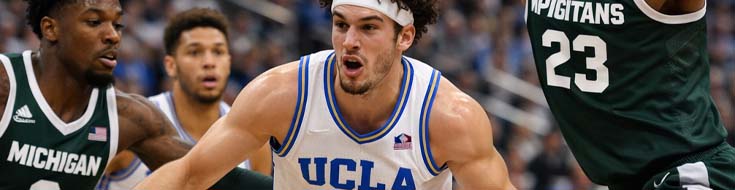
The past 10 years of NCAA tournaments reveal an indisputable reality: teams that manage both sides of the court consistently succeed. Over the past 10 years, the majority of national champions and most of the teams that reach the Final Four were top 20 in both offensive and defensive efficiency. This structural anomaly has caused bettors using the best March Madness sportsbook go beyond team names and look at scoring and defensive stats
The 2026 NCAA Tournament has far clearer predictions than previous years. In recent betting odds, Michigan, Arizona, and Duke have emerged as top contenders, while in bracket predictions, UConn and Houston remain strong. This article examines the NCAA tournament winning team types: balanced, offense-driven, and defense grinders. It will also explain what this means for buyers and bracketologists in relation to the 2026 team predictions.
You’ll learn:
- What characterizes each type of winning team?
- Who conforms to those models in March Madness 2026?
- How can you incorporate efficiency and matchup trends into your bracket or betting strategy?
- What actionable insights can you provide before the tournament begins?
The opportunities are broad, but the best use of the patterns is when the predictability relaxes, and the profit begins to flow.
Balanced Powerhouses: The Dual‑Threat Contenders
Why Balanced Teams Win
Teams that are able to score points and stop their opponent’s scoring are most likely to succeed during March Madness. Champions likely possess both best-in-class offense and best-in-class defense — this is especially true for efficiency in betting on NCAA March Madness.
Detecting and predicting systems, like KenPom and BPI, have shown that some teams have a better chance than most of being successful in both scoring and stopping scoring in the 2026 NCAA March Madness tournament. Looking at the record of Michigan and their offensive and defensive splits, the logical reasoning is that they are a title favorite and are projected to be at the top of the bracket. This team has good offensive strength and the discipline to play good defense, which is the same type of championship teams have had in past March Madness tournaments.
Successful teams in March Madness have the ability to score and stop the opposing team from scoring.
How They Stack Up in 2026
Odds for the 2026 National Title reveal fit prospects with championship potential across the board.
- Predictive futures boards are dominated by Michigan, where depth and efficiency are indicative of a championship-worth profile.
- Duke and UConn are in the same category. With up-and-down squads throughout the history of the program, each has the capacity to win through the grind.
- Although Arizona has a history of being offense-oriented, it seems to have found a good balance in both offense and defense, which is why it is currently one of the top-ranked teams.
When betting on a champion or placing a futures bet, balanced teams are the way to lower risk.
To survive the unpredictability of March, focus on teams with above average metrics on both offense and defense.
Offense‑Driven Juggernauts: When Scoring Overrides All
Primary Insight: The Offense First Mentality
During certain periods of a season, highly powered offenses create dreadfully difficult match-up problems. These types of teams can run away with games early, thus making defensive changes practically irrelevant. When line betting or making a betting bracket, participants must spot offenses that can run up the score on their opponent before the defense has a chance to implement mechanical breaks.
Based on the 2026 season, the legalization of Arizona sports betting shows that Arizona has one of the highest national title odds and has been consistently projected as an offensive team. Arizona is updated to futures pricing and has the top betting odds. When compared to Michigan and Duke, Arizona is considered to have the most offensive dominant betting odds.
Supporting Analysis with Context
Historically, offense-oriented teams that have performed well in the NCAA tournament have had exceptional shooting and scoring versatility. Consider teams that could stretch the defense and create mismatches in the paint and shoot the ball well from three. While their defense may be considerably weaker than the best defensive teams, the overall offensive potential more than makes up for the imbalance.
Should Arizona’s offense get hot in the earlier rounds of the tournament, it could potentially knock off higher-seeded teams with better defenses. Offensively driven teams are also statistically more likely to be upset and advance deep in the tournament in this era of basketball, where three-point shooting and pace of play are the prevailing metrics.
This all suggests that in-game betting, offense-first teams are likely to exceed expectations, especially against opposing defenses that are soft in transition or have poor perimeter shooting defenses.
Risks and Rewards in 2026
With offensive teams, there is always the possibility of variation. If the team is unable to shoot decent shots from three or if they turn the ball over on consecutive possessions, especially during critical moments of the game, the outcome can quickly turn in favor of the opposing team. However, if an offense is playing at a high level, they are literally able to outscore the other team regardless of how strong a defensive team the opponent has.
To continue the analysis of the offensive potential/example of teams that might do well in the tournament, watch how Arizona’s guards perform as March Madness approaches. The guards’ shooting % is a great predictor of how far Arizona will go offensively.
Defensive Grinders: Slow the Game, Squeeze Out Wins
Primary Insight: Defense Changes the Pace
Defense wins championships, goes an adage in basketball. For March Madness 2026, this will certainly still be the case for the teams designed to frustrate shooters, create turnovers, and grind out possessions.
The defensive grinders control the pace of the game. They slow things down and make their opponents fight for every single point. These types of teams are especially good in the closing moments of a game because they make it so easy to miss shots. These types of teams will convert defensive rebounds into fast-break transition buckets.
In metrics like defensive rating, Connecticut and LSU are the best in the business at 100 possessions. Being a grinder is what makes them the best.
Supporting Analysis: Why Defense Matters
Strong defenses have shown to be crucial for championship-winning teams during the latter half of the season. Think of the impact of a solid defense on a low-scoring game win, especially during tournaments where every possession of play is extremely valuable. Virginia won the tournament in 2019, thanks to their defense, allowing it to bounce back from their struggles in the tournament.
By March 2026, teams such as Connecticut and Texas possess the potential to shut down high-quality offensive teams, and, historically, that sort of identity is valuable for tournament success. For the bettors, in NCAA futures betting, these teams should easily be identified as potential championship teams.
The straightforward illustration of the ideology is that high-quality defenses make for low-scoring games and high-quality defenses allow for close games. If a low seed plays a high seed with a fast style of play in the first round, they will likely be able to frustrate the offense and neutralize that strength, which makes that team a good moneyline underdog or good to cover the spread.
Forward‑Looking Evaluation
Be ready to see pace-down and half-court games as the tournament starts. Grinders will exploit the scenario as other teams will push for more possessions. This tires teams out and increases opportunities for last-minute mistakes.
If you are looking to do futures or game-by-game betting, study the last few weeks of the season for trends in defensive efficiency. They are likely to show the teams that are able to deal with high levels of pressure when it matters the most.
Expert Insights: Betting Smarter on March Madness
Focusing On Efficiency Metrics
Most Final Four teams will have a balance of strong offensive and strong defensive teams. While extremes will have success, balance is preferable.
Recent Form Matters
Teams that have performed well in their conference will often continue their success through March. Books often have not properly adjusted because of this.
Matchup Dynamics
Seedings don’t really matter. It’s more about the control of the game and the quality of the shots taken.
Spread Your Bets
When making bets, a blend of game props, future bets, and over/under bets is the best strategy. Balanced teams do well in the futures, while teams that score a lot do well in the scoring props.
Injuries
The loss of a team’s best scorer or best defensive player will greatly alter the whole profile of that team.
The Addition of Cinderella Teams
Cinderella teams are teams that will pull off an upset that very few people are expecting. However, Cinderella teams are expected to have at least one elite trait, whether it’s defense or an extremely good scorer.
Frequently Asked Questions
Q: What is March Madness?
A: March Madness refers to the NCAA Division I men’s basketball tournament, featuring 68 teams in a single‑elimination format to crown a national champion.
Q: Who are the favorites for March Madness 2026?
A: According to recent odds, Michigan, Arizona, and Duke are among the top projected teams to win the 2026 title, with UConn also near the top of bracket projections.
Q: How do I place a bet on March Madness?
A: Use a licensed March Madness sportsbook like BetNow or other regulated operators. Choose a wager type — moneyline, spread, totals, or futures — and follow the sportsbook’s steps to submit your bet.
Q: What types of bets should I consider?
A: You can bet moneylines, point spreads, totals, futures like national title winners, or props (e.g., team scoring, player points).
Q: Which seeds are most likely to make the Final Four?
A: Historically, No. 1 and No. 2 seeds have the highest probability, but top 3–4 seeds often outperform their seed expectations.
Q: Can lower seeds win?
A: Yes. Upsets occur every tournament, and lower‑seeded teams can surprise with the right mix of traits.
Q: What are the risks with betting on March Madness?
A: The main risk is unpredictability. Upsets and momentum shifts can change outcomes quickly, so managing your bankroll and avoiding risky bets is key.
The Key Takeaways for 2026
Looking ahead to the 2026 NCAA tournament, keep these takeaways in mind as you place your bets or finalize your bracket picks:
- Balanced teams like Michigan and UConn give you consistent odds on both ends of the floor.
- Offense-driven powerhouses like Arizona can blow the lid off games, making them dangerous in high-scoring matchups.
- Defensive grinders like Connecticut have a unique edge in controlling game flow, especially against fast offenses.
In short, evaluate the complete picture of team efficiency when making your picks for March Madness. As always, get your bets in early, take advantage of updated odds, and make sure to visit BetNow for the latest insights and picks. The madness awaits!

Hilbert Mayer
Sports Writer
Hilbert Mayer is a professional sports writer, betting analyst, and content strategist with over 15 years of experience in the sports industry. Before focusing on sports betting analysis and handicapping, Hilbert worked as a sports writer for various news outlets, covering everything from game recaps to in-depth matchup features. Today, he specializes in MLB, NFL, March Madness, and UFC betting, combining his journalistic background with deep statistical expertise and real-world betting insights. His proven track record, sharp reads, and ability to break down complex matchups make him a trusted voice among both casual bettors and seasoned sharps.
Published on: March 5, 2026
Last updated: March 10, 2026