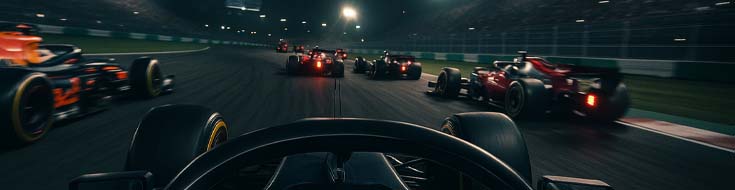
October 26 marks the 20th round of the Formula One World Championship, and as of now, the 2025 Mexico City Grand Prix seems to be the most unpredictable race of the season. Being 2,200 meters above sea level, the circuit at Autódromo Hermanos Rodríguez presents an interesting challenge. As well as dealing with the competition, teams have to anticipate the whims of the sport’s most unpredictable variable — the weather.
The Mexico City race will be interesting to those who follow sports betting online sites. With the numerous fluctuating variables — tire, track temperature, etc. — anything could happen with this race. This article will discuss what makes this circuit unique, what teams and drivers are expected to succeed, what possibly could be the game plans, and what other bettors would find useful to know.
Let’s analyze the trends, the stories, and the statistics that will shape this year’s Mexico City GP, and, with a little luck, your next winning bet.
Altitude and tires: The Unseen Battle
In Mexico’s thin air at over two kilometers above sea level, cars lose about 25% of their aerodynamic efficiency. That’s a lot. Teams counter this by having their cars run maximum wing angles, but even then, cars slide more, forcing the tires to their limits.
Pirelli is bringing C2 (Hard), C4 (Medium), and C5 (Soft) tires for 2025, an aggressive choice that provides flexibility but also exposure. The soft rubber is excellent for qualifying, but the pace can drop significantly during the race. The hard tire can last longer, but will be difficult to manage at the beginning of long stints.
Those who can manage their pace and tires are at an advantage. Max Verstappen, Lando Norris, and Oscar Piastri fit this description, and it is no coincidence that in recent years many races have been won not by speed, but by efficient tire management. There is also a narrow margin between one- and two-stop strategies, meaning a perfectly timed pit call could win the race.
Momentum Wars: Teams on a Collision Course
A championship flashpoint is not just another stop on the calendar.
McLaren arrives in Mexico with both title contenders. Oscar Piastri is leading the championship while Lando Norris is breathing down his neck in second place. The team has the right momentum and consistency, plus they have a low-downforce car which will perform well in Mexico. Expect them to go for the one-two finish.
You can’t count out Red Bull in Mexico. Max Verstappen has won five times; he is the only one winning here. Verstappen’s smooth driving style, combined with Red Bull’s superior efficiency on long straights, makes him the favorite on paper. The narrow setup window for Mexico’s Red Bull cars is a trap. It guarantees an overheating tire if the driver exceeds the setup window on one end.
Ferrari and Mercedes are the two remaining dark horses. Both have shown inconsistent speed. The consistency just does not exist for Mexico. Ferrari’s 2024 win with Sainz recognized that consistency. They can get it right, but it is unlikely perfection will be achieved.
For fans exploring sports betting strategies, this is the section where insight turns into opportunity. Understanding how team momentum shifts, how tire behavior affects qualifying versus race pace, and how different setups respond to altitude can reveal real betting edges.
The conclusion drawn is that there will be narrow margins during both qualifying rounds and race days. When assessing matched betting, the returns on podium betting and “top six finish” markets will be more probable than those on win markets.
How to Play It: Turning Analysis Into Action
How do fans and bettors translate this knowledge into competitive advantages?
- Don’t Overvalue Pole Position. In three of the last five editions of the Mexican GP, winners have come from as far back as third and lower. Race pace and tire life matter more than grid position.
- Bet on Strategy, Not Just Speed. In the end, tire degradation and the timing of pit stops and the resulting open and closed gaps on the rest of the field often lead to flip outcomes. An undercut or a safety-car pit stop can be invaluable in rewriting the leaderboard.
- Focus on Consistent Finishers. Verstappen, Norris, and Piastri, for instance, are proof of this as the drivers in a profitable market for finishing positions in a race. Value markets for top-3 or top-5 positions open late, and that’s where the long-term profits hide.
- Watch Practice and Qualifying Closely. Consistent trends of downward adjustments relative to the market are observed for bettors who refine their position after FP2 or FP3 in a racing weekend.
- Adjust for Conditions. Even small shifts in air density or temperature have a large effect on engine cooling and brake wear.
- Mexico is a race of patience and pattern-spotting. The numbers really do matter, but the real question is how teams adapt on Saturday to predict what will happen Sunday.
Looking Ahead: What Mexico Could Decide
With the championship picture still razor-thin, Mexico is in Round 20 of 24. Oscar Piastri leads, Lando Norris is just behind, and Verstappen is looming close.
Should McLaren get tire and energy management right, they will create a substantial lead to finish off the remaining races. However, if Red Bull continues to perform the way they have been, Verstappen will regain the sought-after momentum going into Brazil and Las Vegas.
Statistically, the Mexico circuit produces fewer DNFs than some of the other high-speed circuits. But when things go wrong, they go wrong. At this altitude, engine failures, brake overheating, and tire blisters are sudden and very possible. Expect a major breakdown of some sort.
My prediction is that Verstappen will still be the benchmark in Mexico. But the way McLaren has been performing, coupled with Piastri’s calm execution, will most likely turn the scales in their favor. The constructors’ title will likely be much closer after this weekend, so willing bettors should be sure to have a balance on their account to account for the quickly changing odds with the fast-moving market.
Expert Insights: Betting Smart for Mexico City GP
Drivers With Altitude Pedigree
Due to the geographical setting, both Mexico and Brazil share the characteristics of high-altitude racing. Drivers who are highly rated in these regions such as Verstappen, tend to replicate their performance consistently.
Use Practice Data as a Predictor
Disregard the media speculation. Long-run pace and tire wear achieved in FP2 remain the most reliable indicators of performance.
Avoid “Winner-Only” Bets
The close of the field and volatility of the variables mean that it makes little sense to place a winner-only bet. It is far more sensible to bet on podium, fastest lap, and head-to-head markets.
Check Team Updates Between Races
As Mexico follows the U.S. GP, these are back-to-back weeks. This means that it is highly likely a team will implement slight upgrades which can impact performance.
Time Your Wagers Wisely
Most of the time, your bet will have the most value between the final practice and the qualifying rounds. At that range, betters can analyze tire and weather data but the market has still not adjusted.
Frequently Asked Questions
Q: Why Speed and Stability Matter in Online Sports Betting?
A: Because racing and betting both move fast on online sports betting platforms. In-play odds shift quickly, and bettors who act decisively — while sticking to stable, tested methods — outperform impulse bettors.
Q: Why does altitude make such a big difference in Mexico?
A: Higher altitudes in Mexico mean the air is thinner, which affects downforce and engine efficiency. Adjustments on engine cooling systems are needed, and also on wing settings to run higher and more effectively.
Q: What tire compounds are used in 2025?
A: Pirelli has chosen to supply C2 (Hard), C4 (Medium) and C5 (Soft), which are a softer tire combination. This is a softer combination than most circuits, which allows for a greater number of strategies.
Q: Who’s historically best at Mexico?
A: Max Verstappen has 5 wins, which is the record for all drivers. Red Bull has an optimal setup for the combination of straights and slow corners at this track.
Q: Does qualifying matter here?
A: Qualifying does help, but it is not the most important factor. Overtaking is not easy, but it is still possible, and there are smart tire strategies.
Q: Are pit-stop bets worth considering?
A: Absolutely. The high surface temperatures combined with altitude make tire wear and strategy unpredictable. The teams that go long on the mediums are in stark contrast to those who aim to undercut very early.
Q: How many races remain after Mexico?
A: There are 4. Mexico is the start of the final suite for the championship, where every point is vital.
Q: What external factors could change the race?
A: Changes to the track, unanticipated rainfall, issues with overheating, or debris resulting in a safety car. Any one of these could change the strategy and the probabilities in a matter of seconds.
Final Lap: Ready to Bet and Watch
The Mexico City Grand Prix is more than a race — it’s a masterclass in adaptation. Altitude limits downforce, tires behave unpredictably, and even small setup mistakes can cost huge.
For bettors, that means opportunity. Focus on teams and drivers who manage change, conserve tires, and execute clean strategies. Remember that speed alone doesn’t win here — precision and patience do.
As the 2025 season enters its final act, Mexico could redefine both championships and betting trends. So watch every lap, study the patterns, and when you’re ready to act, head to BetNow to find the latest motorsport markets and odds.
Because in Mexico, everything — from grip to glory — is up for grabs.

Hilbert Mayer
Sports Writer
Hilbert Mayer is a professional sports writer, betting analyst, and content strategist with over 15 years of experience in the sports industry. Before focusing on sports betting analysis and handicapping, Hilbert worked as a sports writer for various news outlets, covering everything from game recaps to in-depth matchup features. Today, he specializes in MLB, NFL, March Madness, and UFC betting, combining his journalistic background with deep statistical expertise and real-world betting insights. His proven track record, sharp reads, and ability to break down complex matchups make him a trusted voice among both casual bettors and seasoned sharps.
Published on: October 25, 2025
Last updated: October 26, 2025