
Upon opening a sportsbook, you might encounter a line displayed as +150 on one page and 2.50 on another. Are you looking at the same bet? Not knowing how to convert and read the different types of odds might leave you with a missed winning opportunity, or worse, a wager with a skewed potential risk and reward.
Haphazardly betting on odds due to a poor understanding of the different formats (American, Decimal, and Fractional) can also lead to missed opportunities. This is a common problem at the beginner’s level, and value is often left on the table when comparing the lines at different sportsbooks.
This guide will address how each type works, describe implied probability, and present simple conversion formulas and tables to aid confident betting on any sportsbook.
You will learn:
- What betting odds really mean.
- Reading odds in American, Decimal, and Fractional formats.
- Conversion formulas explained step-by-step.
- Finding and comparing odds across sportsbooks.
- A cheat sheet you can print out for quick access.
Quick Reference: Betting Odds Formats
- Three Global Formats:
- American (Moneyline) – Positive and negative numbers (+150, -110).
- Decimal – Total payout for each $1 wagered (2.50, 1.91).
- Fractional – Profit to stake ratio (3/2, 10/11).
- Implied Probability – The odds given for an outcome and the odds number determines the outcome odds.
- Formulas for Quick Conversion:
- To convert from American odds to decimal odds (positive), use the formula: Decimal = (American / 100) + 1.
- To convert from American odds to decimal odds (negative), use the formula: Decimal = (100 / |American|) + 1.
- To convert decimal odds to a fractional form, use the formula: Fractional = Decimal – 1 (then convert to a ratio).
- To convert a fractional odds to a decimal, use the formula: Decimal = (Numerator / Denominator) + 1.
- Example Side-by-Side:
- All the values given below represent the same bet:
- +150 = 2.50 = 3/2
- Regional Usage:
- In the United States, people use American odds. In the United Kingdom, people use fractional odds. In Europe, Australia, and Canada, people use decimal odds.
Why Understanding the Different Formats of Odds is Important
Betting odds determine the stake and the potential returns, along with the implied probability of the underlying event. Understanding the odds being used is required to make informed and strategic betting rather than reckless gambling.
Due to the risk of misinterpreting the odds, you stand to lose important betting opportunities as a result of a confusing bet format, make reckless gambles with unaccountable potential returns, and could overlook the vast difference in odds of one bookmaker compared to another.
Here are the formats used within various geographic areas:
| Region | Most Common Format | Rationale |
|---|---|---|
| USA | American | Originated from moneyline betting |
| UK | Fractional | Stems from the historical tradition of horse racing |
| Europe and Australia | Decimal | Simplest computation of total returns |
To maintain profitability and optimize returns, professional gamblers must understand and compute various formats and odds systems. Able to adjust and interchange formats allows bettors the ability to execute line shopping. Even marginally better odds on a multiple selection bet accumulates a profitable return over an betting season.
Explaining the Different Odds Systems
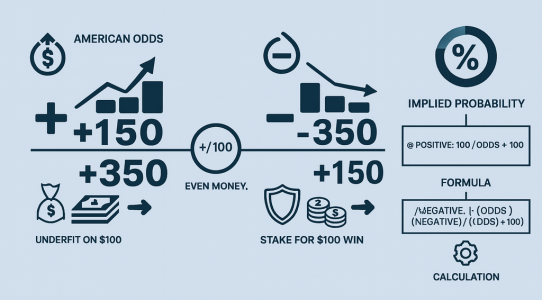
American Odds (Moneyline)
In the US, moneyline odds or American odds are most prevalent. Although they may initially appear confusing, the system is built around logic and is based on a simple principle.
The system revolves around a $100 benchmark. However, bettors have the flexibility to place a wager of any amount.
Understanding the Positive Odds (Underdog)
Positive odds express the total profit earned on a $100 stake. It is important to note that this is profit, meaning the amount earned is on top of the stake amount that was returned.
- For +150, that means you would make $150 in profit from a $100 bet (and a $250 total return).
- For +200, that means you would earn $200 in profit from a $100 bet (and a $300 total return).
- For +350, that means you would earn $350 in profit from a $100 bet (and a $450 total return).
The higher standing on a positive number, the higher the underdog. A +350 team is much less likely to win compared to a +150 team, therefore a sportsbook is more likely to give a higher profit to the +350 team.
- For different stake sizes, $50 with +150 odds would profit a return in total of $125.
- For $25 with +200 odds, the total return would be $75.
Reading Negative Odds (Favorites)
Negative odds demonstrate how much you would have to stake to gain $100 in profit. This is the other perspective compared to positive odds which focuses on $100 winnings.
Interpretation:
- A line of -150 means you have to place a $150 bet in order to win $100, which will bring your total payout to $250.
- A line of -200 means you have to place a $200 bet to win $100, making your total payout $300.
- A line of -350 means you have to place a $350 bet to win $100, making your total payout $450.
The higher the absolute value of the negative number, the heavier the favorite. A team at -350 is assumed heavily more likely to win than a team at -150 in which case you are risking more money with less reward.
For bets other than $100, for example, a line at -150 at a $50 stake:
- Profit = $50 * (100/150) = $50 * 0.667 = $33.33.
- Total return = $50 + $33.33 = $83.33.
For a $300 stake with -200 odds:
- Total return = $300 + $150 = $450.
Understanding Even Money
A line at +100 or -100 is “even money”, meaning you are risking the same amount you are expecting to win. If you bet $100 at even odds, you will also win $100 making your total return $200. This is the threshold of underdogs and favorites.
Determining Your Payout
- With positive odds, the formula is: (Stake * American odds / 100) + Stake
- With negative odds, the formula is: Stake * 100 / |American odds| + Stake
(Stated simply, | | is used as “absolute value” which means you take the negative off the number).
Implied Probability
Every odds set shows hidden information, which is the sportsbook saying how likely that outcome is to come true. This is called implied probability.
- For positive odds, the formula is: 100 / (American + 100)
- Implied probability example: +150 odds
- Implied probability = 100 / (150 + 100) = 100 / 250 = 0.40, or 40%.
- For negative odds, the formula is: |American| / (|American| + 100).
- Implied probability example: -150 odds
- Implied probability = 150 / (150 + 100) = 150 / 250 = 0.60, or 60%.
Take notice that +150 and -150 are not opposites. The sportsbook thinks the favorite at -150 is very likely to win, 60% probability, while the underdog at +150 is very likely to lose, only 40 probability.
Comprehensive Examples
| Stake | Odds | Profit | Total Return | Implied Probability |
|---|---|---|---|---|
| $100 | +150 | $150 | $250 | 40% |
| $100 | -150 | $66.67 | $166.67 | 60% |
| $50 | +200 | $100 | $150 | 33.3% |
| $50 | -200 | $25 | $75 | 66.7% |
| $200 | +120 | $240 | $440 | 45.5% |
| $200 | -120 | $166.67 | $366.67 | 54.5% |
Decimal Odds
Decimal Odds are by far the simplest format of odds which is why they are the global standard. This is the case in Europe, Australia, Canada, and many more countries. There is no positive or negative to think about; just one simple number that tells you everything.
How Decimal Odds Work
Decimal odds indicate your profits and the total returns, meaning the original stake and the profit, for each dollar you place on a wager. This is the primary difference with american odds, which conceptually separates the stake and the profit.
Examples:
- 2.50 implies that for each $1 stake, you obtain $2.50 in total (including your $1 stake).
- 3.00 implies that for each $1 stake, you obtain $3.00 in total.
- 1.67 implies that for each $1 stake, you obtain $1.67 in total.
Basic Formulas
You can find your total return by multiplying your stake by the decimal odds.
- Example 1: $100 bet at 2.50 odds
- Total return = $100 * 2.50 = $250.
- Profit = $250 – $100 = $150.
- Example 2: $75 bet at 3.20 odds
- Total return = $75 * 3.20 = $240.
- Profit = $240 – $75 = $165.
- Example 3: $200 bet at 1.75 odds
- Total return = $200 * 1.75 = $350.
- Profit = $350 – $200 = $150.
The best part about this system is that it is completely transparent. You can determine your total payout by simple multiplication, which eliminates the need to determine if the bet is on an underdog or favorite.
Identifying Favorites vs Underdogs
It is essential to understand what 2.00 means in decimal odds:
- 2.00 = Even money (risk $100 to win $100)
- Anything over 2.00 = Underdog (the greater the odds, the greater the underdog)
- 2.50 = moderate underdog
- 3.00 = significant underdog
- 5.00 = major underdog
- 10.00 = extreme longshot
- Anything below 2.00 = Favorite (the greater the odds below, the heavier the favorite)
- 1.90 = slight favorite
- 1.67 = moderate favorite
- 1.40 = heavy favorite
- 1.20 = overwhelming favorite
Number 2.00 is your mental anchor – everything concerns odds that are higher, or lower, than this point.
Implied Probability
Decimal odds means calculating implied probability is simple:
1 / Decimal odds
- Example 1: 2.50 odds
- Implied probability = 1 / 2.50 = 0.40 or 40%
- Example 2: 1.67 odds
- Implied probability = 1 / 1.67 = 0.60 or 60%
- Example 3: 3.00 odds
- Implied probability = 1 / 3.00 = 0.333 or 33.3%
This simplicity is what makes decimal odds favorable for probability estimation. The calculations are simple enough to perform in your head, illuminating mental pathways for rapid decision-making.
Why Bettors Prefer Decimal Odds
There are no hidden definitions when it comes to presenting returns in decimal odds. With American odds, it can be tricky to figure out whether the mentioned odds are winning odds or losing odds. Factional odds, one would need to do some arithmetic to figure out what the return would be. With decimal odds, all one needs to know is how much the returns are.
This simplicity is very helpful when one needs to evaluate several bets in a short time or in the case of a parlay where decimal odds need to be multiplied to find the total odds.
Holistic Cases
| Stake | Odds | Profit | Total Return | Implied Probability |
|---|---|---|---|---|
| $100 | 2.50 | $150 | $250 | 40% |
| $100 | 1.67 | $67 | $167 | 60% |
| $50 | 3.00 | $100 | $150 | 33.3% |
| $50 | 1.50 | $25 | $75 | 66.7% |
| $200 | 2.20 | $240 | $440 | 45.5% |
| $200 | 1.83 | $166 | $366 | 54.6% |
Fractional Odds
Fractional odds are the traditional format in the United Kingdom and remain the global standard for horse racing. While they might look intimidating if you’re unfamiliar with fractions, they elegantly express the relationship between risk and reward.Receiving and interpreting returns would be more complex if fractional odds were to be used in other gambling activities.
Understanding Fractional Odds
In writing odds and dsting profits, setting odds is communicated with a fraction. In the range of odds, the numerator represents the profit and the stake is the denominator. This can be depicted as numerator/denominator.
Numerator (top number) = potential profit. denominator (bottom number) = amount of stake required.
A fraction represents the statement, “for every [ denominator] amount of stake, you will profit [numerator]”.
Examples would include:
- 3/2: ‘three to two’ profits a total of $3 if a $2 homestake is filled.
- 2/1: ‘two to one’ profits a total $2 if a $1 homestake is filled.
- 5/1: ‘five to one’ profits a total of $5 if a $1 homestake is filled.
- 1/2: ‘one to two’ profits a total of $1 if a $2 stake is homestaked with.
Reading Common Fractions
- Even money can be: 1/1 or Abound stake = profit.
- Denominator is larger than denominator representing an underdog. This can range in values of:
- 3/2: moderate underdog.
- 2/1: significant underdog.
- 5/1: major underdog.
- 10/1: extreme longshot.
- 100/1: nearly impossible.
- A denominator smaller than the numerator represents the stake as a favorite. This can range in values of:
- 1/2: moderate favorite.
- 1/3: heavy favorite.
- 1/4: overwhelming favorite.
- 1/10: near certainty.
Calculating Your Profit
Calculation of profit can be done with the use of a given formula of stake and fraction. In this case stake would be $100 and the odds at 3/2.
Profit is calculated as $100 * (3 / 2) = $100 * 1.5 = $150. Therefore, the total return is $100 + $150, which is $250.
Let’s take as a second example a $50 bet at 5/1 odds. The profit is calculated as $50 * (5 / 1) = $50 * 5 = $250. The total return is calculated as $50 + $250 which is $300.
In example 3, a $200 bet is set at 1/3 odds. The profit is $200 * (1 / 3) = $200 * 0.333 = $66.67. The total return is calculated as $200 + $66.67, which is $266.67.
If the odds are set as a simple fraction, some bets can be calculated rather quickly. With 2/1 odds, simply double your stake for profit. Bet $100, profit $200. With 3/1 odds, triple your stake for profit. Bet $100, profit $300. With 1/2 odds, your profit is half your stake. Bet $100, profit $50. With 1/1 odds (or evens), your profit equals your stake. Bet $100, profit $100. For more complex fractions like 11/8 or 100/30, most bettors convert to decimal form for easier calculation.
Implied Probability
Formula: Denominator / (Numerator + Denominator)
- Example 1: At 3/2 odds
- Implied probability = 2 / (3 + 2) = 2 / 5 = 0.40 or 40%
- Example 2: At 2/3 odds
- Implied probability = 3 / (2 + 3) = 3 / 5 = 0.60 or 60%
- Example 3: At 5/1 odds
- Implied probability = 1 / (5 + 1) = 1 / 6 = 0.167 or 16.7%
Why Some Bettors Prefer Fractional Odds
Fractional odds clearly separate your profit from your stake, which some bettors find conceptually easier. When you see 5/1, you instantly know you’re risking relatively little for a potentially large reward. The visual representation of the ratio makes the risk-reward relationship obvious.
In the context of horse racing, fractional odds are particularly notable, having survived the test of time, primarily due to their ability to express the long-shot potential of races. Odds such as 33/1 and 50/1 instantly relay the message: “This horse rarely wins.”
Comprehensive Examples
| Stake | Odds | Profit | Total Return | Implied Probability |
|---|---|---|---|---|
| $100 | 3/2 | $150 | $250 | 40% |
| $100 | 2/3 | $66.67 | $166.67 | 60% |
| $50 | 2/1 | $100 | $150 | 33.3% |
| $50 | 1/2 | $25 | $75 | 66.7% |
| $100 | 5/2 | $250 | $350 | 28.6% |
| $100 | 2/5 | $40 | $140 | 71.4% |
All Three Formats Compared
To illustrate that these odds are diverse ways of expressing the same information, consider identical bets as represented in the three different formats, as shown below.
| Format | Stake | Profit | Total Return | Implied Probability |
|---|---|---|---|---|
| American | +150 | $100 | $150 | 40% |
| Decimal | 2.50 | |||
| Fractional | 3/2 | $100 | $150 | 40% |
Another example showing a favorite:
| Format | Stake | Profit | Total Return | Implied Probability |
|---|---|---|---|---|
| American | -150 | $100 | $66.67 | 60% |
| Decimal | 1.67 | |||
| Fractional | 2/3 | $100 | $66.67 | 60% |
And an even money example:
| Format | Stake | Profit | Total Return | Implied Probability |
|---|---|---|---|---|
| American | +100 | $100 | $100 | 50% |
| Decimal | 2.00 | |||
| Fractional | 1/1 | $100 | $100 | 50% |
All three formats communicate identical information and are merely restating the potential return on your bet and the implied probability of that outcome.
Different scales are a question of regional preference and historical convention.
The recognition of this equivalence is indeed liberating. If you understand that +150, 2.50, and 3/2 represent the same bet in three different forms, you can confidently approach any sportsbook around the globe. You are no longer restricted by the familiarity of a particular format. You understand the universal language of betting odds.
Converting from American Odds to Decimal Odds
- Positive: (American odds / 100) + 1 (Example: +150 → (150 / 100) + 1 = 2.50)
- Negative: (100 / |American odds|) + 1 (Example: -150 → (100 / 150) + 1 = 1.67)
- Decimal → American odds:
- If Decimal Odds ≥ 2.00: (Decimal – 1) * 100 (Example: 2.50 → (2.50 – 1) * 100 = +150)
- If Decimal Odds < 2.00: -100 / (Decimal – 1) (Example: 1.67 → -100 / 0.67 = -150)
- Decimal to Fractional: subtract 1, then convert to fraction. (Example: 2.50 → 1.50 = 3/2)
- Fractional to Decimal: (Numerator / Denominator) + 1 (Example: 3/2 → 1.5 + 1 = 2.50)
| American Odds | Decimal Odds | Fractional Odds | Implied Probability |
|---|---|---|---|
| +100 | 2.00 | 1/1 | 50% |
| +150 | 2.50 | 3/2 | 40% |
| +200 | 3.00 | 2/1 | 33.3% |
| -110 | 1.91 | 10/11 | 52.4% |
| -150 | 1.67 | 2/3 | 60% |
| -200 | 1.50 | 1/2 | 66.7% |
Real-World Application: Finding Value Across Sportsbooks
Suppose you want to bet on an underdog in an NBA playoff game, and you are checking multiple sportsbooks.
- BetNow (US format): +150
- European sportsbook: 2.40
- UK betting site: 6/4
To make it easier, convert everything to decimal:
- BetNow +150 → 2.50
- European book → 2.40 (already decimal)
- UK book 6/4 → 2.50
For a $100 bet:
- On BetNow (2.50): Total return is $250 Profit is $150
- On a European book (2.40): Total return is $240 Profit is $140
Choosing BetNow over the European sportsbook allows you an added profit of $10. Even a $10 profit might appear trivial, professional bettors will have dozens of bets a season. Regularly seeking better odds remains profitable, as over an extended period, the marginal profit improves significantly.
Assuming rated odds:
- BetNow (2.50): 40%
- BetNow European book (2.40): 41.7%
The European sportsbook assigns a higher probability (less value) to the outcome. If you think a team has a 45% chance of winning, BetNow priced better.
Odds format common questions
Q: Why convergence if my sportsbook shows my preferred format?
A: Because you might be leaving value on the table. Professional bettors will have their accounts on multiple books for a reason.
Q: I am not good at math. Is there an easier way?
A: Certainly! Take advantage of online odds converters, betting apps that include calculators, and the conversion table provided in this guide. Also, you can switch odds formats and do the conversions in sportsbooks. For most bettors, the mental calculations are not worth the effort, as understanding the core logic and flow will make you a more intelligent bettor.
Moving Forward
- Use BetNow for practice: Take a few bets, select odds in different formats, and practice the conversions. There are different formats and expressions for the same odds.
- Use the cheat sheet: For easier line comparisons, download the conversion reference table to your phone.
- Check the racebook: Horse racing has fractional odds, which are more common. You can visit the racebook to see different betting contexts for these odds.
It’s important to note that the ability to read different odds formats is only one part of the betting process. The more important element is the ability to make profitable betting decisions. The part that separates a sharp bettor from an average one is the ability to recognize and extract value from a bet. You can tell if this value has been masked by any format.
Take this opportunity to practice your conversions with our sportsbook’s various odds formats. Feel free to bookmark this guide and begin line shopping across different books to ensure you get maximum value on every bet.

Hilbert Mayer
Sports Writer
Hilbert Mayer is a professional sports writer, betting analyst, and content strategist with over 15 years of experience in the sports industry. Before focusing on sports betting analysis and handicapping, Hilbert worked as a sports writer for various news outlets, covering everything from game recaps to in-depth matchup features. Today, he specializes in MLB, NFL, March Madness, and UFC betting, combining his journalistic background with deep statistical expertise and real-world betting insights. His proven track record, sharp reads, and ability to break down complex matchups make him a trusted voice among both casual bettors and seasoned sharps.
Published on: October 17, 2025
Last updated: October 17, 2025